 Itemlume
PRACTICAL ANSWER / Assets & tasks
Should AI-written product guides invent a specialist author profile?
No. Do not assign a guide to an invented photographer, engineer, or other specialist, or imply that someone independently tested a product when they did not. Name the real organization responsible for the guide, describe AI assistance accurately, and connect factual claims to sources readers can check.
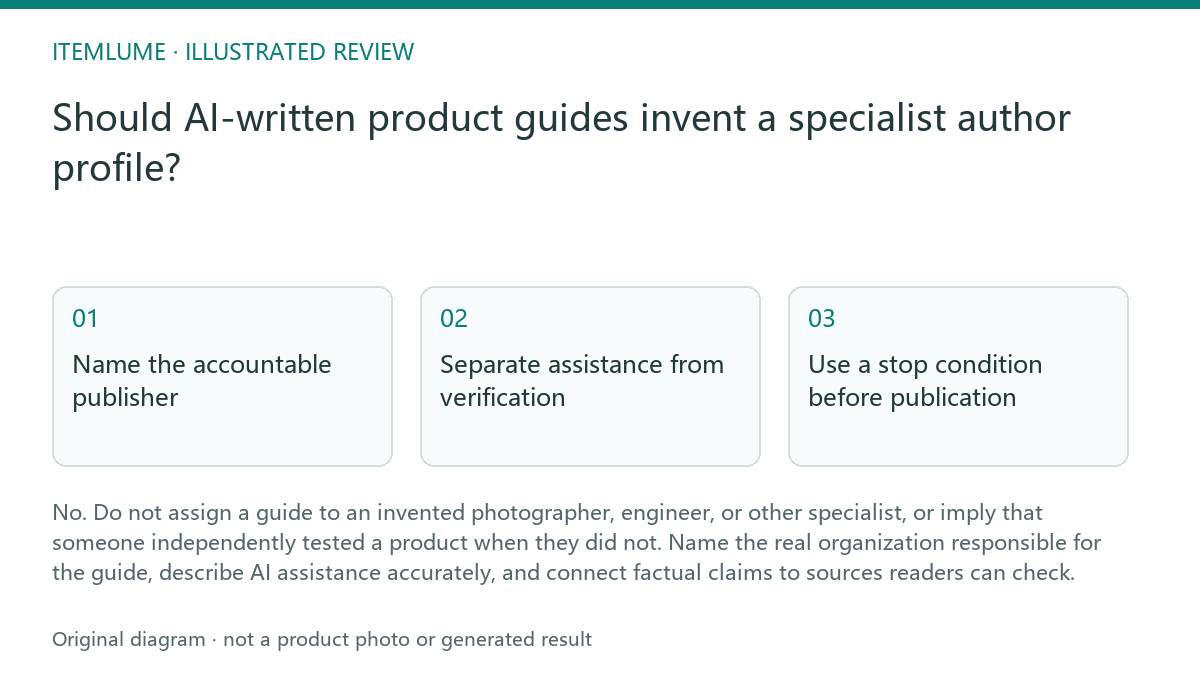
Name the accountable publisher
A product guide needs a clear line of responsibility, not a fictional biography. Use the name of the real organization that commissioned, reviewed, or published it. If a real editor made a meaningful contribution, credit that person only with their permission and an accurate description of their role.
Do not invent a photographer with ten years of experience, a certification, a laboratory, or a first-person product test to make the page sound authoritative. A polished author box does not turn unsupported claims into evidence. If no individual author is appropriate, an honest organization-level byline is clearer than a made-up person.
Separate assistance from verification
Say what happened: for example, AI helped draft or organize the guide, and a named editorial organization reviewed it. Do not suggest that AI assistance itself verifies a fact. A human review should identify what was actually checked, not imply specialist credentials or hands-on testing that did not occur.
Build a source trail for factual statements. Prefer the relevant primary document, such as a manufacturer’s specification for a stated feature, and link close to the claim. A source supports only what it says: a product page is not proof of independent performance, fit, or durability testing. Mark examples as fictional and recommendations as editorial judgment where readers might otherwise confuse them with findings.
- Underline claims about specifications, performance, fit, credentials, and testing.
- For each claim, identify the original source and confirm it supports that exact wording.
- Check author and reviewer names, roles, and permissions with the real people or organization.
- Remove unsupported claims or label illustrative scenarios as fictional; then review the byline and disclosure together.
Use a stop condition before publication
Pause publication if a reader could reasonably infer that an invented specialist exists, that a named person tested the product, or that a source proves more than it does. Do not repair that impression with softer wording around a false biography. Remove the profile, correct the claim, or obtain real, relevant verification before proceeding.
Keep the disclosure proportionate and specific. State the actual editorial organization and the actual role of AI; avoid vague claims such as “expert verified” unless a real qualified reviewer performed and approved the stated review. Recheck links and attribution when the guide changes, especially if edits add new product claims.
Work through a fictional draft
Fictional exercise: a draft credits “Maya Chen, product photographer with ten years of experience,” and says she tested a camera bag. The team confirms no such contributor or test exists. The draft also says the bag is waterproof, citing only a retailer listing that repeats a manufacturer description.
Remove the invented profile and testing statement. Credit the actual publishing organization, disclose that AI assisted drafting if that is what occurred, and link the waterproof claim to the manufacturer’s relevant documentation. If that documentation does not establish the claim precisely, narrow or remove it. The guide passes only when its byline, disclosure, and evidence describe the real work.
Author and evidence review
| Observation | Next check | Pass condition |
|---|---|---|
| A named specialist has a detailed biography | Confirm the person, role, contribution, and permission | Every detail is real and the credited work was performed |
| The guide says a product was tested | Check who tested it and what the record supports | A real test occurred and the wording matches its scope |
| A waterproof claim links to a retailer listing | Trace the statement to relevant manufacturer documentation | The cited source supports the exact claim, or the claim is narrowed |
| AI helped write or organize the guide | Compare the disclosure with the actual workflow | The disclosure is accurate and does not imply AI verified facts |
Sources and further reading
Sources for this page were checked on . Platform rules can change; verify the current source before publishing. Prompt examples and workflow recommendations are Itemlume editorial guidance, not independently measured results.
Frequently asked questions
Can an organization be the author?
Yes. Credit the real organization responsible for the guide when an individual byline would be misleading or unsupported.
Should every AI-assisted guide name a human reviewer?
Name a person only when they genuinely reviewed the guide and agree to the attribution. Describe their actual role.
Does a manufacturer source prove independent testing?
No. It may support a manufacturer-stated feature, but it does not establish that an independent test occurred.
BUILD FROM A PRODUCT YOU KNOW
Put this workflow into practice with your own product.
Explore the relevant tool first. AI copy and concept planning are free after sign-in. Image and video generation require available credits and the applicable account access.
Open Assets & tasks Check pricing and credits