 Itemlume
Assets & tasks / PRACTICAL ANSWER
How can readers check the evidence behind my AI-written product guide?
Make the claim, its source and its limits visible together. A long source list at the bottom does not prove every sentence.
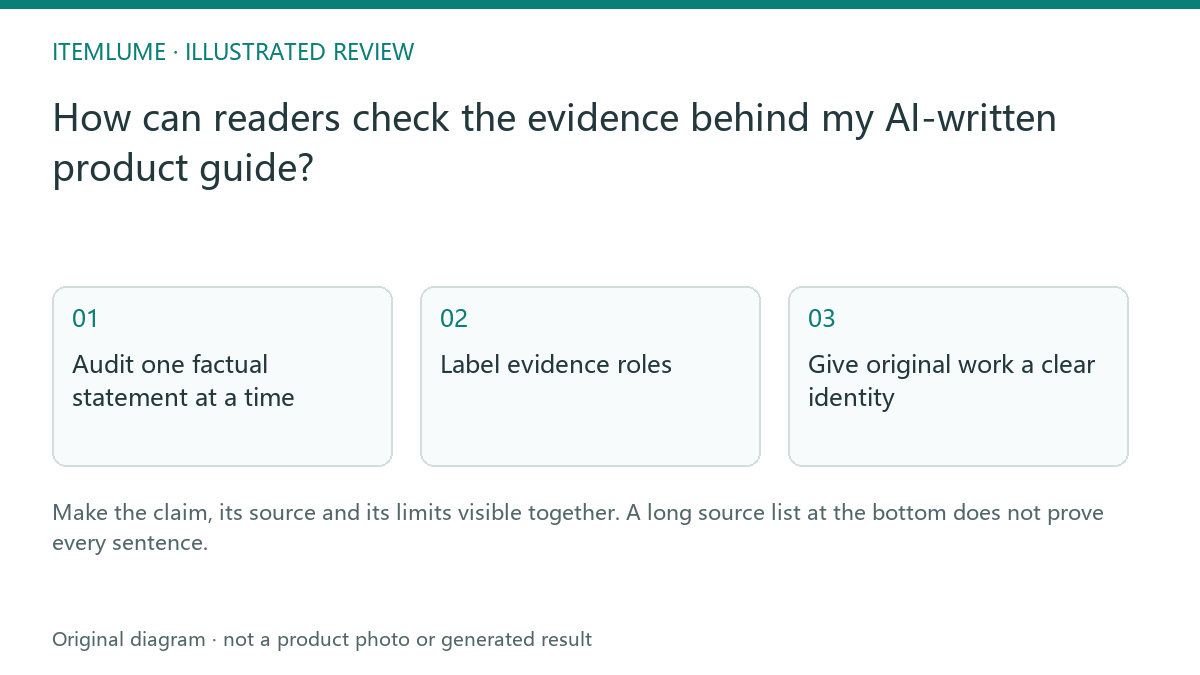
Audit one factual statement at a time
A fictional seller drafts “this generated image is accepted by every marketplace.” The attached link leads to a generic design-tool homepage. That source does not establish the claim. Replace the statement with a specific supported publishing requirement, a link to the relevant current platform page and a clear scope. Remove assertions that remain unsupported.
An AI research assistant can suggest sources, but it can also attach an irrelevant reference. Open the actual page and verify the relationship yourself. A confident answer or familiar domain is not enough.
Label evidence roles
| Material | What it supports | What it does not establish |
|---|---|---|
| Platform documentation | Its described current rule | Approval of this particular image |
| Vendor tutorial | The vendor’s described workflow | Independent comparative success |
| Owned test | The documented tested result | Average performance across users |
| Fictional worksheet | How to make a decision | Actual product or campaign data |
Use the role appropriate to each statement. Do not turn a vendor’s quality claim into your own tested result or describe self-published promotion as independent editorial endorsement.
Give original work a clear identity
If your guide adds a worked example, describe it as your exercise and explain its purpose. Use your own prose and diagrams rather than copying the competitor’s article structure sentence by sentence. The original value can be a useful decision ledger or a narrowly tested failure case; it does not require invented statistics.
For the marketplace statement, a small preflight table is more useful than a sweeping acceptance promise. Keep exceptions and unresolved checks adjacent to the recommendation.
Review before and after publishing
Check source destinations, public access, dates and the final visible text. Keep a correction record when a source changes or an error is found. Readers should be able to inspect the relevant primary evidence without signing into your private workflow. This improves verifiability; it does not establish that search engines or assistants will cite the article.
Sources and further reading
Sources for this page were checked on . Platform rules can change; verify the current source before publishing. Prompt examples and workflow recommendations are Itemlume editorial guidance, not independently measured results.
Frequently asked questions
Is a homepage enough for a detailed claim?
Use a source that directly supports the statement.
Are vendor tutorials independent tests?
No. Describe them as the vendor’s material.
Can fictional examples be useful?
Yes, when clearly labeled and used to teach a decision.
BUILD FROM A PRODUCT YOU KNOW
Put this workflow into practice with your own product.
Explore the relevant tool first. AI copy and concept planning are free after sign-in. Image and video generation require available credits and the applicable account access.
Open Assets & tasks Check pricing and credits