 Itemlume
PRACTICAL ANSWER / Product images
Is a photo saved from a messaging app good enough for AI product editing?
A saved chat photo can be usable if it still shows the details your edit must preserve. Judge the downloaded file, not the preview inside the conversation. Compare it with the camera original when possible. If lettering, embossing or edges have disappeared, request the original file; sharpening cannot establish what the missing detail actually was.
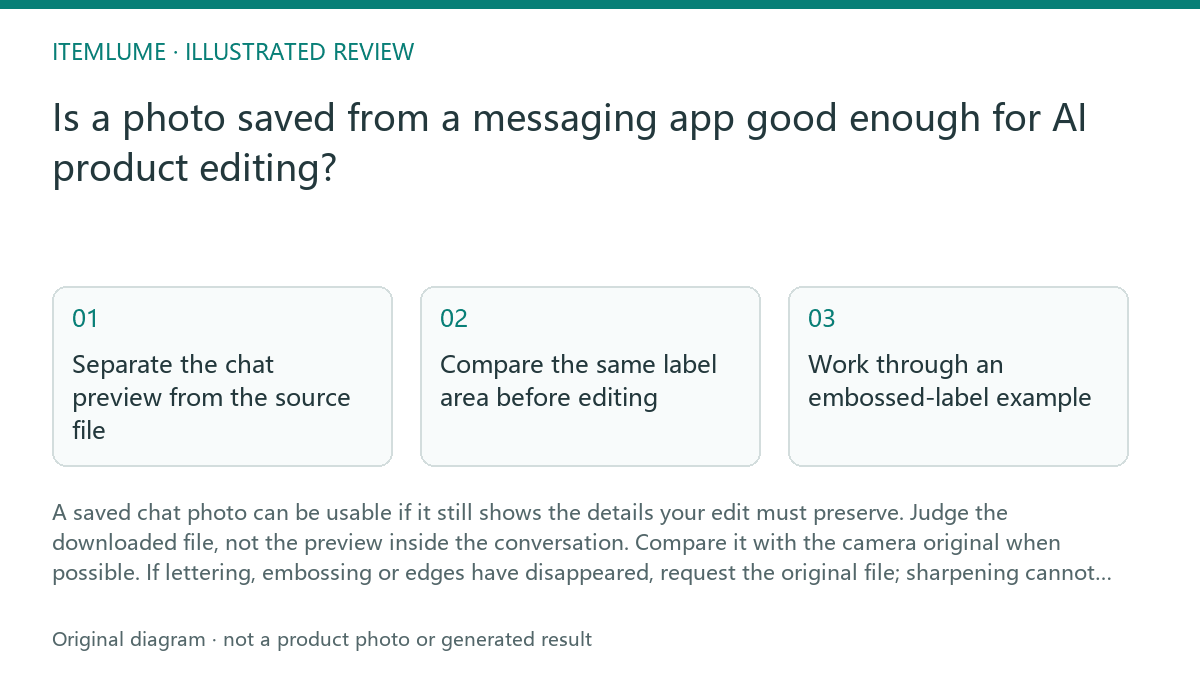
Separate the chat preview from the source file
Messaging apps can send a reduced image, an original attachment or a preview of an attached file. Delivery options vary, so receiving a photo in chat does not by itself prove compression. Download the attachment and inspect its pixel dimensions. A large file size alone does not establish that product detail survived.
Ask the supplier for the camera file through a transfer method that preserves it, rather than a screenshot of the photo. Screenshots can capture a resized display and interface elements. Keep the received version and the original separately so you can trace which reference supported the edit.
Compare the same label area before editing
Choose a detail that matters to product identity: an embossed mark, a narrow letter stroke, a seam or a small opening. Compare the same area in both files at matching displayed product sizes. Otherwise, a larger display can make one version appear more informative without revealing additional evidence.
Compression may flatten shallow relief, create blocks around lettering or add ringing beside hard edges. Blur in the original suggests a capture problem instead. Follow this sequence before deciding whether the chat copy is usable.
- Download the actual received file and record its pixel dimensions.
- Obtain the corresponding camera original and confirm it shows the same product and view.
- Align a crop of the important detail at the same displayed size in both versions.
- Check letter boundaries, embossed relief and adjacent edges for lost or altered structure.
- Accept the copy only if every detail required by the planned edit remains verifiable.
Work through an embossed-label example
Fictional exercise: a supplier sends a photo measuring 900 pixels along its long edge. The product outline looks clear, but a small embossed label appears as a smooth patch. The proposed edit changes the background while keeping the product unchanged. Treat that label as unresolved before submitting the reference.
Request the original and compare the label crop. If distinct raised letter edges appear there, use the original as the reference. If the original also hides the lettering, request a fresh close-up with lighting that reveals the relief. A typed transcription can help review wording, but it cannot establish the letters’ physical shape or placement.
Stop when product evidence runs out
Stop the editing workflow when a required identifying detail remains unreadable in every available photograph. Do not use AI enhancement to decide what the embossing says or how it is formed. A clearer generated mark may be plausible while differing from the actual product. Obtain another photograph before approving that detail.
After editing, compare the output with the accepted source at the label, silhouette and fine edges. Reject invented strokes or changed relief even if the scene looks cleaner. These checks are user workflow advice; Itemlume does not prove product details or performance, and a generated image does not replace source evidence.
Pass/fail review for a messaging-app reference
| Observation | Next check | Pass condition |
|---|---|---|
| Outline is clear; embossed label looks flat | Compare the same label crop with the camera original | Pass if required raised strokes remain distinguishable; fail if they merge |
| Blocks or bright fringes surround lettering | Inspect those boundaries in the original | Pass if the reference retains verifiable letter edges; fail if artifacts obscure them |
| Both files show a blurred label | Request a focused close-up with light revealing the relief | Pass when the new photograph resolves the required detail; otherwise stop |
| Edited label looks sharper than the source | Match each visible stroke and its position to source evidence | Pass if the source supports the structure; fail if the edit invents it |
Sources and further reading
Sources for this page were checked on . Platform rules can change; verify the current source before publishing. Prompt examples and workflow recommendations are Itemlume editorial guidance, not independently measured results.
Frequently asked questions
Does sending a photo as a file guarantee the original?
No. Ask the sender to select the camera original; attaching a previously compressed copy preserves that copy’s losses.
Can I use a chat photo just to plan a background?
Yes, if it is sufficient for discussing composition. Recheck the reference before producing an image that must preserve fine product details.
Should I delete the compressed version after receiving the original?
Keep it labeled as the chat copy if it forms part of the review history. Make the accepted source unmistakable.
BUILD FROM A PRODUCT YOU KNOW
Put this workflow into practice with your own product.
Explore the relevant tool first. AI copy and concept planning are free after sign-in. Image and video generation require available credits and the applicable account access.
Open Product images Check pricing and credits