 Itemlume
PRACTICAL ANSWER / A+ product pages
Should I advertise the rated capacity or the usable capacity?
Show the capacity that answers the buyer’s question, and name it precisely. A brim-full measurement, a recommended fill and an electronic device’s nominal capacity are different claims. Do not present one as another or use AI to convert between them as proof of performance. State the unit and relevant measurement conditions beside each value.
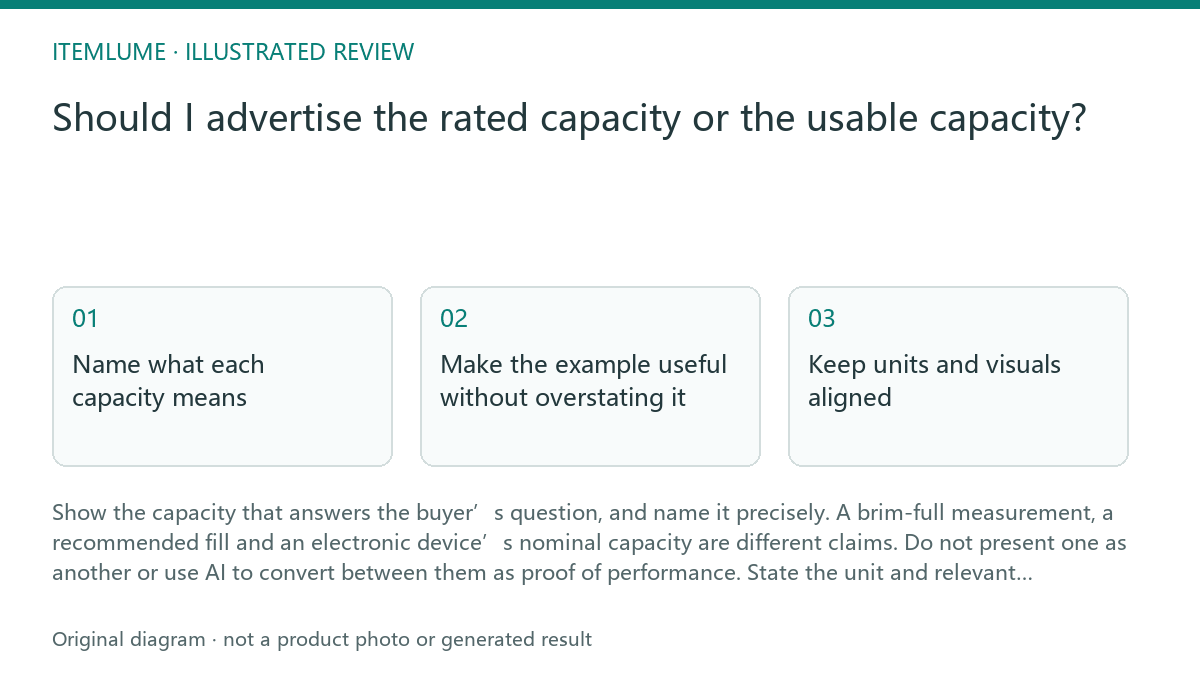
Name what each capacity means
For a container, brim-full volume is the amount it holds when filled to its rim under the stated measurement method. Recommended fill is the amount intended for ordinary use, which may leave room at the top. Neither number should be labeled simply “capacity” when showing both: that leaves buyers to guess which value applies to their use.
For an electronic product, rated or nominal capacity is a specification associated with the device or its battery. It is not a container-volume measurement, and it should not be presented as a guaranteed usable output unless the supporting product documentation says so. Keep terms distinct even when the same unit appears.
- List each source value and the document or test record that supports it.
- Identify whether the value is brim-full, recommended fill, or an electronic rating.
- Check that the unit and measurement conditions match the claim.
- Write a separate label for each value; remove unsupported conversions or performance implications.
Make the example useful without overstating it
In this fictional exercise, a jar holds 500 ml to the brim and has a recommended fill of 420 ml. A clear A+ line would say: “Brim-full volume: 500 ml. Recommended fill: 420 ml.” The figures are fictional and illustrate labeling only; they are not product research or a universal fill rule.
If the page has room, add the condition used to obtain each value, such as how the jar was filled and where the brim reference was taken. Use only conditions you can document. Do not infer that the 80 ml difference is a safety margin, spill allowance or performance benefit unless evidence supports that explanation.
Keep units and visuals aligned
Place the unit directly beside its value and keep the same unit across a comparison when practical. If values come from different methods, disclose that difference rather than implying an exact like-for-like comparison. A visual fill line should correspond to the labeled recommended amount, not merely make the larger number look more appealing.
Review the image and accompanying text together. A headline that says “500 ml usable” would contradict a 420 ml recommended-fill label in the fictional example. Avoid rounding, unit conversion or AI-generated calculations that add precision or imply an unverified relationship. Use approved source figures and have the responsible product owner confirm them.
Review the claim before publishing
Treat every displayed value as a claim that needs a source, a definition and a matching unit. If the source only gives a nominal electronic rating, do not relabel it as delivered or usable capacity. If the method is unknown, pause the comparison and ask for a documented measurement instead of filling the gap with plausible-sounding copy.
The review below is an editorial check, not a product test. A pass means the wording matches the evidence available for the claim; it does not prove product performance or guarantee that every buyer will use the item in the same way. Stop and remove or qualify any value whose meaning or source cannot be verified.
Capacity claim review
| Observation | Next check | Pass condition |
|---|---|---|
| Jar shows 500 ml at the rim and 420 ml recommended fill | Check the source for both measurements and the fill reference | Both values are labeled separately with ml and documented conditions |
| A graphic marks the recommended fill line | Compare the line with the documented 420 ml measurement | The line does not imply that brim-full volume is the usable amount |
| Electronic product lists a nominal capacity | Check the product documentation for the exact rating and unit | Copy says nominal or rated and makes no unsupported usable-output claim |
| Values use different methods or units | Confirm whether a documented conversion or comparison is appropriate | Method differences are disclosed; unsupported conversion is removed |
Sources and further reading
Sources for this page were checked on . Platform rules can change; verify the current source before publishing. Prompt examples and workflow recommendations are Itemlume editorial guidance, not independently measured results.
Frequently asked questions
Should I show both container values?
Yes, when both help the buyer. Label brim-full volume and recommended fill separately, with units and supported conditions.
Can I call the recommended fill the usable capacity?
Use the term only if it accurately describes the documented amount and does not imply a different measurement.
Can AI calculate usable capacity from a rated value?
No. A calculation does not establish what the rating means or prove usable performance. Use documented product information.
BUILD FROM A PRODUCT YOU KNOW
Put this workflow into practice with your own product.
Explore the relevant tool first. AI copy and concept planning are free after sign-in. Image and video generation require available credits and the applicable account access.
Open A+ product pages Check pricing and credits