 Itemlume
PRACTICAL ANSWER / Assets & tasks
Should a Chinese product guide point its canonical URL to the English version?
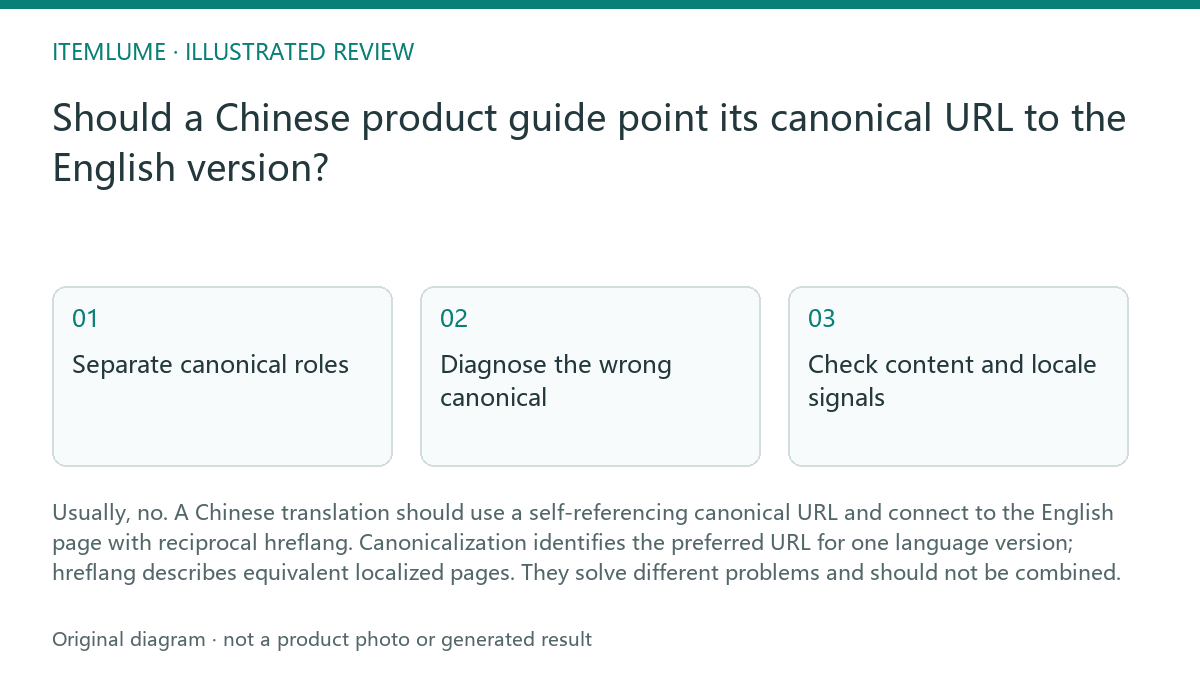
Usually, no. A Chinese translation should use a self-referencing canonical URL and connect to the English page with reciprocal hreflang. Canonicalization identifies the preferred URL for one language version; hreflang describes equivalent localized pages. They solve different problems and should not be combined.
Separate canonical roles
A Chinese product guide should normally canonicalize to its own Chinese URL, such as `/zh/guides/product-guide`. The English guide should canonicalize to its own English URL, such as `/guides/product-guide`. This tells search systems that each page is the primary version at its own address, rather than treating the translation as an accidental duplicate.
Use hreflang to associate the language versions, for example `en` pointing to the English URL and `zh-CN` pointing to the Chinese URL. Each page should include the other language version in the reciprocal set, and each localized page should list itself. This is implementation guidance for page owners; it is separate from any documented publishing or planning functionality.
- 1. Open the English page and record its exact canonical URL.
- 2. Open the Chinese page and verify that its canonical points to the Chinese URL, with the same URL normalization rules.
- 3. Compare both hreflang sets: English points to Chinese, Chinese points to English, and both point to themselves.
- 4. Check that language-specific title, body, links, and structured data match the intended locale.
- 5. Inspect each URL independently; do not treat a successful live validation as proof that either URL has been indexed.
Diagnose the wrong canonical
A Chinese page pointing to the English URL can cause the Chinese document to be treated as a duplicate or secondary representation. That may be especially confusing when the Chinese page has different examples, navigation, support links, or product terminology. First determine whether the pages are translations of one guide or genuinely different documents; only equivalent localized versions belong in one hreflang cluster.
Do not use canonical tags to express language preference. A canonical is a URL relationship, while hreflang is a language-and-region relationship. If the Chinese URL redirects to English, has noindex, or contains a canonical aimed at English, fix that page-level configuration before interpreting crawl or indexing results. The diagnosis should use the rendered HTML and actual response behavior, not only a CMS preview.
Check content and locale signals
The two pages can share the same core instructions while still using natural local wording, localized links, and appropriate metadata. Keep the main claim equivalent, but review examples and terminology that could change meaning. For this guide, the English workflow and its Chinese translation are separate public pages; neither should be merged into one bilingual body solely to simplify canonical handling.
A fictional example makes the relationship concrete: suppose an English page is `/guides/credits` and its Chinese translation is `/zh/guides/credits`. The English page self-canonicalizes and lists `zh-CN` for the Chinese URL. The Chinese page self-canonicalizes and lists `en` for the English URL. This fictional example does not predict rankings, traffic, or indexing outcomes.
Review before release
Run the checks in a staging or controlled release process, then repeat them after deployment because templates, redirects, and localization middleware can change the final HTML. Confirm that both URLs return the intended language, remain publicly reachable when they are meant to be discovered, and expose one consistent reciprocal hreflang set.
Stop the diagnosis when the canonical is self-referencing on both localized pages, reciprocal hreflang is present and syntactically consistent, the rendered language matches the URL, and no redirect or noindex rule contradicts the intended discovery path. At that point, separate indexing investigation from implementation repair; live rich-result validation, where applicable, does not prove indexing.
Topic-specific review
| Observation | Next check | Pass condition |
|---|---|---|
| Chinese page canonical points to English | Inspect rendered canonical and response redirects | Chinese URL self-canonicalizes and remains the intended localized address |
| Only one side lists hreflang | Compare the complete sets on both pages | English and Chinese URLs list themselves and each other with matching language codes |
| Chinese page contains English navigation or metadata | Review the rendered title, headings, links, and structured data | User-facing signals match the Chinese locale without changing the guide’s core meaning |
| Live validation succeeds but page is absent from search | Check crawlability, indexing directives, response status, and site-level discovery | Implementation is correct; indexing remains a separate observation, not a claimed result |
Sources and further reading
Sources for this page were checked on . Platform rules can change; verify the current source before publishing. Prompt examples and workflow recommendations are Itemlume editorial guidance, not independently measured results.
Frequently asked questions
Should both language pages share one canonical URL?
No. Equivalent localized pages should generally use self-referencing canonical URLs and reciprocal hreflang.
Does hreflang guarantee that the Chinese page will be indexed?
No. It associates language alternatives. It does not guarantee crawling, indexing, rankings, or traffic.
Can I publish one bilingual page instead?
You can choose a single bilingual document as a content decision, but that is different from maintaining separate English and Chinese localized URLs.
BUILD FROM A PRODUCT YOU KNOW
Put this workflow into practice with your own product.
Explore the relevant tool first. AI copy and concept planning are free after sign-in. Image and video generation require available credits and the applicable account access.
Open Assets & tasks Check pricing and credits