 Itemlume
PRACTICAL ANSWER / Assets & tasks
Will FAQ schema still give my ecommerce guide expanded Google results?
No. As of October 2026, Google no longer supports FAQ rich results for ordinary ecommerce guides. Google confirmed the feature was discontinued on May 7, 2026. You may still use valid Schema.org FAQPage markup to describe question-and-answer content, but valid semantics do not guarantee a Google enhancement, indexing, ranking, or AI citation.
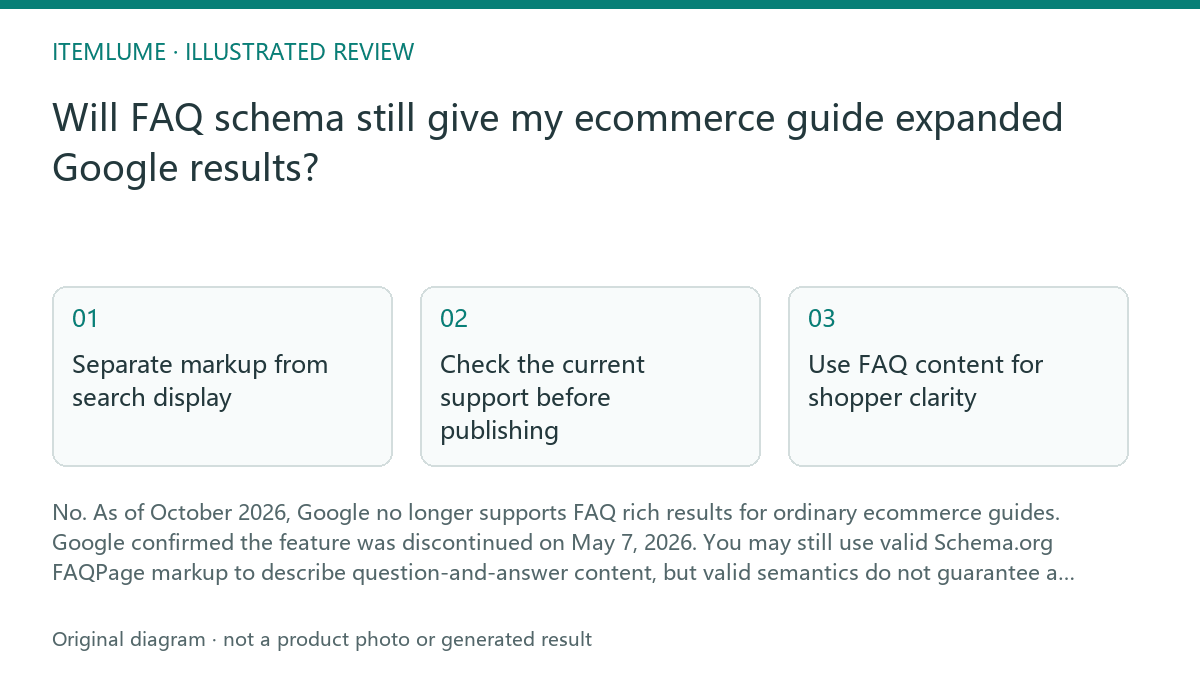
Separate markup from search display
FAQPage markup and a Google rich result are different things. Markup describes content in a machine-readable format; a rich result is a search presentation controlled by Google. A page can contain valid FAQPage properties and still show only its ordinary title link and snippet. For an ecommerce guide, the practical value of the markup is semantic clarity, not a promised expanded listing.
Do not treat the schema validator as a preview of Google’s search page. Schema.org validity means the vocabulary and structure are acceptable under Schema.org rules. Google’s live rich result validation checks Google-supported features, but a successful test does not prove that Google will index the page, select the markup, or display any enhancement.
Check the current support before publishing
The relevant change is dated May 7, 2026: Google’s updates page confirmed that FAQ rich results were discontinued. That date matters when reviewing older ecommerce templates, SEO checklists, or agency recommendations that still describe FAQ markup as a route to an expanded Google result. In October 2026, those instructions are outdated for this use case.
Keep the questions visible on the page and answer them for shoppers first. A useful FAQ can clarify eligibility, setup, credits, media quotes, or workflow boundaries even when Google displays no FAQ treatment. Keep every answer accurate, concise, and consistent with the guide body; do not add questions solely to increase markup volume.
- 1. Open Google’s current structured-data documentation and confirm whether FAQ rich results are supported for your page type.
- 2. Check that every marked-up question and answer is visible to readers on the same page.
- 3. Run Schema.org or Google validation to catch syntax and property errors.
- 4. Inspect the indexed page separately; validation success is not proof of indexing or search display.
- 5. Remove any forecasted traffic or appearance claim that depends on an FAQ rich result.
Use FAQ content for shopper clarity
For an ecommerce guide, write FAQs around decisions that block action: what the service includes, which inputs are quoted separately, what the workflow cannot prove, and what the buyer should review before approval. Do not present planning as store publishing, media generation as guaranteed product performance, or a semantic markup test as search distribution.
A strong answer also separates documented functionality from workflow advice. For example, you can explain that Itemlume planning is free after sign-in while image and video media are quoted separately. You can then label your review checklist as editorial guidance rather than implying that Google or Itemlume guarantees a result.
Review the page before release
Treat FAQ markup as one small part of a source chain. The page should have a clear purpose, self-canonical URL, and reciprocal hreflang links where localized versions exist. The Chinese version should faithfully translate the same claims rather than introducing stronger promises. Neither language version should imply that valid FAQ semantics create Google support or AI citation eligibility.
Use a stop condition: if the page depends on an expanded FAQ result to justify publication, pause and revise the business case. Publish only when the guide remains useful as a normal indexed page with visible answers, accurate product boundaries, and no unsupported search or conversion forecast.
FAQ support review
| Observation | Next check | Pass condition |
|---|---|---|
| Guide claims FAQ schema will create an expanded Google result | Compare the claim with Google’s current structured-data documentation | Claim removed or rewritten as unsupported expectation |
| Markup passes Schema.org validation | Confirm the questions and answers are visible in the guide | Every marked-up item is reader-visible and accurate |
| Google validation test passes | Check indexing and search appearance separately | No statement treats validation as proof of indexing or display |
| Localized guide uses FAQ markup | Inspect canonical and reciprocal hreflang links | Each language page self-canonicalizes and points to its alternate |
| FAQ answers mention product boundaries | Compare each answer with documented functionality | No answer promises publishing, production dielines, fit proof, or performance proof |
Sources and further reading
Sources for this page were checked on . Platform rules can change; verify the current source before publishing. Prompt examples and workflow recommendations are Itemlume editorial guidance, not independently measured results.
Frequently asked questions
Can I still use FAQPage markup on an ecommerce guide?
Yes, if the questions and answers are visible and the markup accurately describes them. Treat it as semantic structure, not a promised Google enhancement.
Does a valid rich-result test mean Google will show the FAQ?
No. Validation checks eligibility or syntax for supported features; it does not prove indexing, ranking, or display.
Should I delete every FAQ from the page?
No. Keep useful shopper questions, but write them for clarity and trust rather than for a discontinued rich-result format.
BUILD FROM A PRODUCT YOU KNOW
Put this workflow into practice with your own product.
Explore the relevant tool first. AI copy and concept planning are free after sign-in. Image and video generation require available credits and the applicable account access.
Open Assets & tasks Check pricing and credits