 Itemlume
DIAGNOSTIC GUIDE / A+ product pages
How do I distinguish total shelf life from remaining shelf life at dispatch?
Separate total shelf life from the remaining time of the batch actually dispatched. A documented interval from manufacture does not mean each buyer receives that entire interval after delivery. Use authentic batch dates and the seller’s real dispatch policy; do not let AI infer expiry from package appearance. Use the actual stock evidence and state when any remaining-period promise is evaluated.
Total shelf life is not remaining time at arrival
Manufacturing date, printed expiry, dispatch date and a minimum-remaining-life promise answer different questions. Subtracting dates is only useful once the actual batch and meaning of each field are confirmed. A static creative may become inaccurate if the advertised remaining period is tied to stock that has changed.
Keep manufacture date, printed expiry, dispatch date and any remaining-life policy in different fields. A total interval measured from manufacture cannot be copied as the time every buyer has after receipt. Dates are meaningful only for the actual batch and the documented definition.
Bind the copy to the batch actually dispatched
Record the current batch identifier and the dates supplied by its approved records. Ask the seller whether any minimum remaining life is actually promised at dispatch or delivery. Keep that policy separate from total shelf life, check the wording against current stock, and remove a time-sensitive claim when its supporting batch is no longer the dispatched one.
Ask the seller whether a minimum remaining period is actually promised and whether its reference point is dispatch or delivery. Record the batch supporting that statement. A static banner needs review when stock changes, even if its package shape and total-life label remain the same.
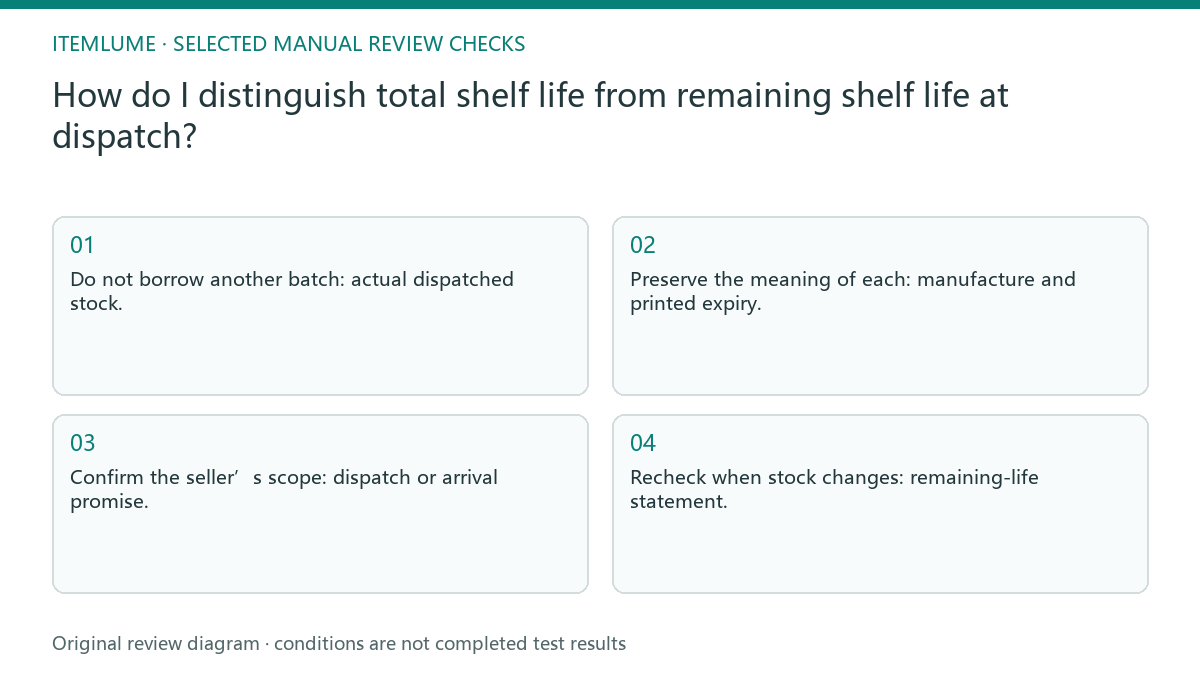
- Do not borrow another batch: actual dispatched stock.
- Preserve the meaning of each: manufacture and printed expiry.
- Confirm the seller’s scope: dispatch or arrival promise.
- Recheck when stock changes: remaining-life statement.
An older batch shares the same total-life label
Fictional exercise: a product has a documented total shelf-life statement, but the shop’s current batch was manufactured earlier. The seller records actual dates and does not copy the total interval into “remaining on arrival.” No food-safety advice or guaranteed minimum is manufactured by the draft.
The fictional product’s old and current batches have the same total-life statement but different manufacture dates. The worksheet explains why that statement cannot serve as an arrival guarantee. The exercise is not a freshness inspection and does not determine whether any product is safe to consume. If several batches can ship under one SKU, ask which remaining-life statement the seller can actually support across that route. Do not select the newest batch solely to calculate a stronger headline. A conservative unknown is preferable to a guarantee built on the wrong stock.
Remove a claim when its supporting stock changes
Stop if batch dates or the point at which a promise applies are unclear. Request the actual stock policy rather than turning an example calculation into a public guarantee.
Stop if the batch or applicable promise point is unknown. Resolve the actual stock route before writing a remaining-period guarantee. The seller owns batch selection and dispatch commitments. Itemlume can organize confirmed facts; it cannot inspect inventory, certify shelf life or determine whether a product is safe to use.
Batch identity to current copy: decision worksheet
| Check | Evidence to record | Review action |
|---|---|---|
| Batch identity | Actual dispatched stock | Do not borrow another batch |
| Date records | Manufacture and printed expiry | Preserve the meaning of each |
| Policy point | Dispatch or arrival promise | Confirm the seller’s scope |
| Current copy | Remaining-life statement | Recheck when stock changes |
Use this matrix as a manual review record and add your own real evidence. Its conditions are not completed test results.
Sources and further reading
Sources for this page were checked on . Platform rules can change; verify the current source before publishing. Prompt examples and workflow recommendations are Itemlume editorial guidance, not independently measured results.
Frequently asked questions
Does a long total shelf life guarantee long remaining life?
No. Remaining time depends on the actual batch and the promise’s reference point.
Can AI read an unclear printed expiry by guessing?
No. Obtain a readable authentic record instead of inventing a date.
Does the example give consumption-safety advice?
No. It explains copy scope and does not assess whether a product is safe to use.
BUILD FROM A PRODUCT YOU KNOW
Put this workflow into practice with your own product.
Explore the relevant tool first. AI copy and concept planning are free after sign-in. Image and video generation require available credits and the applicable account access.
Open A+ product pages Check pricing and credits