 Itemlume
DIAGNOSTIC GUIDE / Assets & tasks
How should a Chinese product guide disambiguate a brand with a homophone?
A Chinese brand sharing a pronunciation with another name needs clear factual context, not repeated keyword stuffing. Use the verified characters, product category, and actual model or offer to identify your business. Add pinyin only where it helps readers understand a real name. Consistent identification may reduce ambiguity, but it does not guarantee search ranking or an AI citation.
Establish the name the owner actually uses
Confirm the exact Chinese characters and any official English name or pinyin with the owner. Do not create an alternate brand name solely because it matches a popular query. Record the actual site and product identity without collecting another business’s private details or claiming ownership of a similar name.
Separate a phonetic collision from a true alias. Users may type a homophone incorrectly, but that does not make the mistaken spelling your official brand. A short clarification can explain the distinction while keeping the approved name primary. Avoid turning every title into a list of unrelated similar characters.
Add product context where readers need it
Describe the category and actual offer near the name: what the business sells and which product the article covers. The context should be supported and specific enough to distinguish the entity. A bare brand mention repeated across a page is less useful to a reader than a clear subject and answer.
Use the same verified identification in about information, relevant guide introductions, and contact or product pages as appropriate. These are editorial consistency recommendations, not evidence of an algorithm’s exact ranking preference. Do not say a competitor is unrelated on legal or ownership grounds unless the owner has appropriate evidence.
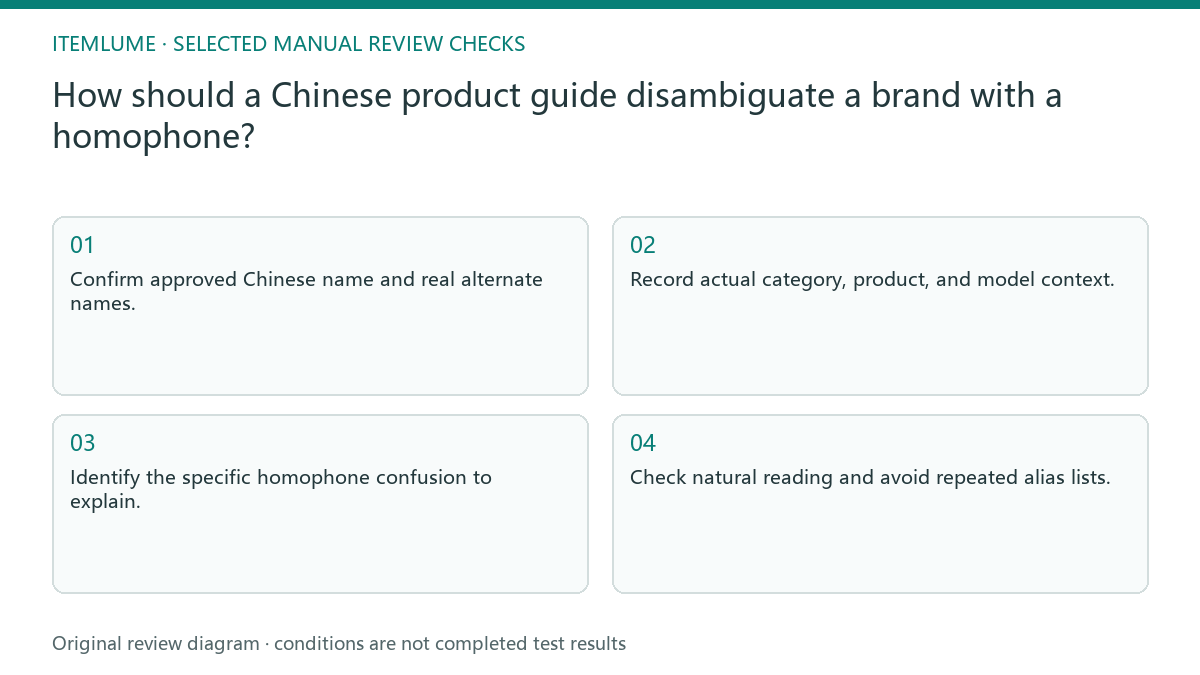
- Confirm approved Chinese name and real alternate names.
- Record actual category, product, and model context.
- Identify the specific homophone confusion to explain.
- Use a short truthful clarification at relevant locations.
- Check natural reading and avoid repeated alias lists.
A fictional storage-brand clarification
Fictional exercise: a storage-product brand has a name pronounced like a different lifestyle phrase. A draft repeats both spellings in every heading. The reviewer instead gives the real brand characters and a concise category description in the introduction. The names and situation are hypothetical; no ranking experiment was performed.
The FAQ can explain the exact spelling when that is a real customer question. If a proposed alias has never been approved, remove it. Stop when the clarification begins claiming that the site is the official representative of another similar entity or invents an organizational relationship.
Measure discovery separately from name consistency
After actual publication, record what user question and URL you check, in which search or conversation product, and on what date. A prompt containing the URL demonstrates a different task from an unprompted brand question. Do not convert a clean entity description into a statement that ChatGPT, Doubao, or DeepSeek already recommends the site.
Itemlume can assist with confirmed copy but cannot guarantee external indexing or citations. Keep a stable factual name and useful product answers while tracking real results separately. Stop keyword expansion when it obscures the article’s question; accurate entity context should help the reader rather than crowd out the content.
Brand identification record
| Element | Evidence | Use |
|---|---|---|
| Chinese spelling | Owner-approved name | Primary identification |
| English or pinyin name | Actual approved alias | Only where helpful |
| Product context | Real category and model | Disambiguate subject |
| Discovery statement | Dated actual query evidence | Do not claim untested recommendation |
Use this matrix as a manual review record and add your own real evidence. Its conditions are not completed test results.
Sources and further reading
Sources for this page were checked on . Platform rules can change; verify the current source before publishing. Prompt examples and workflow recommendations are Itemlume editorial guidance, not independently measured results.
Frequently asked questions
Should I list every homophone?
No. Explain a specific observed confusion where useful; avoid unrelated repeated spelling lists.
Does pinyin guarantee AI recognition?
No. Use it as truthful reader context, not a promised ranking technique.
Can I call another name an alias?
Only when the owner confirms it is an actual approved name. A common typo is not automatically an official alias.
BUILD FROM A PRODUCT YOU KNOW
Put this workflow into practice with your own product.
Explore the relevant tool first. AI copy and concept planning are free after sign-in. Image and video generation require available credits and the applicable account access.
Open Assets & tasks Check pricing and credits