 Itemlume
DIAGNOSTIC GUIDE / Logo studio
Which simplified or traditional Chinese spelling is the approved brand name?
Use the brand owner’s approved names before converting simplified and traditional characters. A general text converter can produce a plausible spelling that is not the intended brand version. Keep regional display names, the identity master and any fixed legal or operating names separately recorded. Keep the official written mark and confirmed search aliases distinguishable in every public asset.
Brand identity is more than character conversion
Character conversion and brand naming are not the same decision. Some characters have multiple mappings or intentionally chosen forms. A designer should not infer an official regional version from a visually attractive glyph or automatically rewrite a name already confirmed by the business.
Separate the approved brand name, descriptive product text and legacy written variants. A character conversion tool may change an intentionally chosen wordmark or create a form the brand has never approved. Similar pronunciation is not proof two spellings identify the same business.
Create an approved name-and-variant register
Ask the owner to approve the exact character sequence for each intended market. Record the master name, allowed display version and fields that must not change. Compare concepts character by character, retain the approved source text beside the artwork, and ask suitable readers to read the actual version rather than guessing its intended name.
Record each approved form with its role: display name, searchable alias or historical note. Keep model codes and source links beside the name. Ask the brand owner which form belongs on the logo and packaging; descriptive prose may follow a different locale convention.
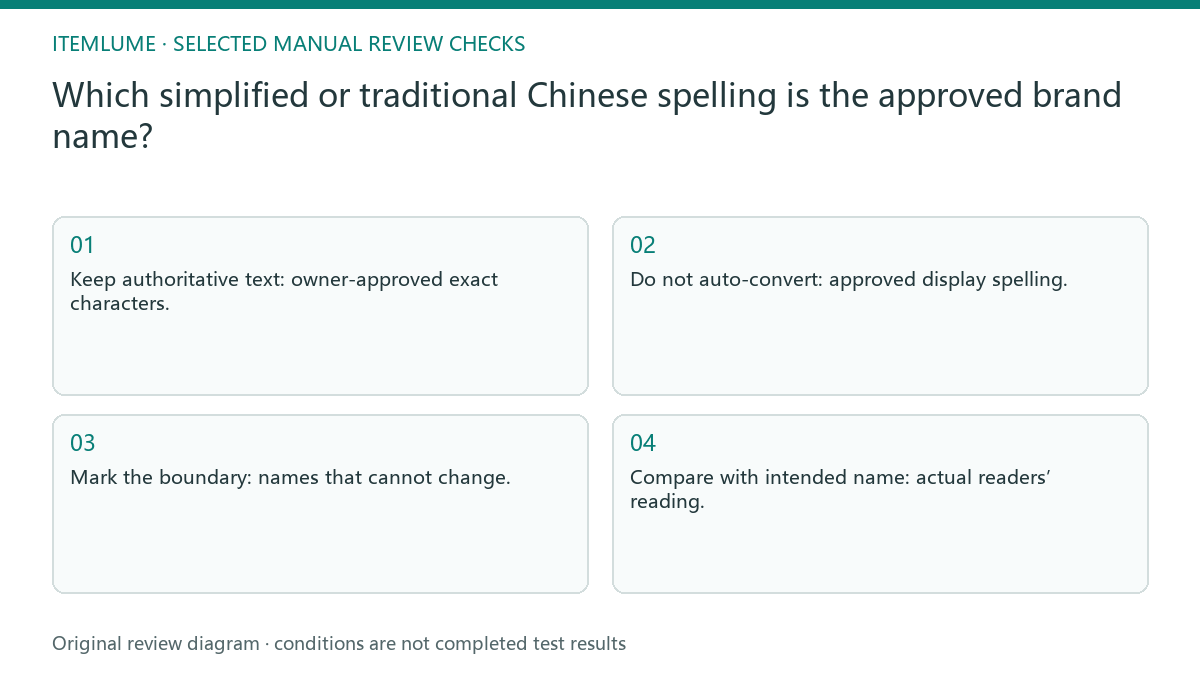
- Keep authoritative text: owner-approved exact characters.
- Do not auto-convert: approved display spelling.
- Mark the boundary: names that cannot change.
- Compare with intended name: actual readers’ reading.
A Chinese wordmark with a deliberate written form
Fictional exercise: a tea-shop owner approves one simplified name and one traditional display form. The designer stores both and rejects a converter’s alternative character that changes the chosen name. The exercise makes no claim about registration, font rights or whether the name can be protected.
The fictional brand keeps its approved written mark while recording a confirmed alternate search form separately. A reviewer checks logo artwork, page heading and product copy against the register. This exercise does not establish a real trademark registration or verify any namesake business. If two public pages use competing names, compare their approved source before selecting a master. Do not decide from which spelling gets more search suggestions. Keep a confirmed legacy alias visible only in its intended role, so readers can distinguish the current brand from a namesake.
Resolve names before changing public assets
Stop if the name owner has not approved the regional spelling. Keep the variant labeled as a concept instead of silently making it the master.
If the owner has not approved a variant, leave it out of the master identity. Search convenience should not silently rewrite the product’s official name. The brand owner approves name identity, and the designer manages files. Itemlume can produce concepts but cannot confirm an official translation or infer trademark status.
Master name to reading proof: decision worksheet
| Check | Evidence to record | Review action |
|---|---|---|
| Master name | Owner-approved exact characters | Keep authoritative text |
| Regional version | Approved display spelling | Do not auto-convert |
| Fixed fields | Names that cannot change | Mark the boundary |
| Reading proof | Actual readers’ reading | Compare with intended name |
Use this matrix as a manual review record and add your own real evidence. Its conditions are not completed test results.
Sources and further reading
Sources for this page were checked on . Platform rules can change; verify the current source before publishing. Prompt examples and workflow recommendations are Itemlume editorial guidance, not independently measured results.
Frequently asked questions
Should every traditional character be automatically simplified?
Not in an approved brand mark. Confirm the owner’s chosen form before conversion.
Can an alias replace the official display name?
Only if approved for that role; otherwise keep the alias explicitly separate.
Does the register prove trademark rights?
No. It organizes approved naming information, not legal ownership.
BUILD FROM A PRODUCT YOU KNOW
Put this workflow into practice with your own product.
Explore the relevant tool first. AI copy and concept planning are free after sign-in. Image and video generation require available credits and the applicable account access.
Open Logo studio Check pricing and credits