 Itemlume
DIAGNOSTIC GUIDE / Virtual try-on
Can a white coat make an AI skincare model look like an expert endorsement?
A white coat, clinical setting and authoritative wording can imply an expert endorsement even when the person is generated. Review the whole impression, not just whether a doctor is named. For a skincare advertisement, separate a fictional presenter from any real professional evidence, and check the current advertising rules in the actual placement. An AI label does not validate an implied credential.
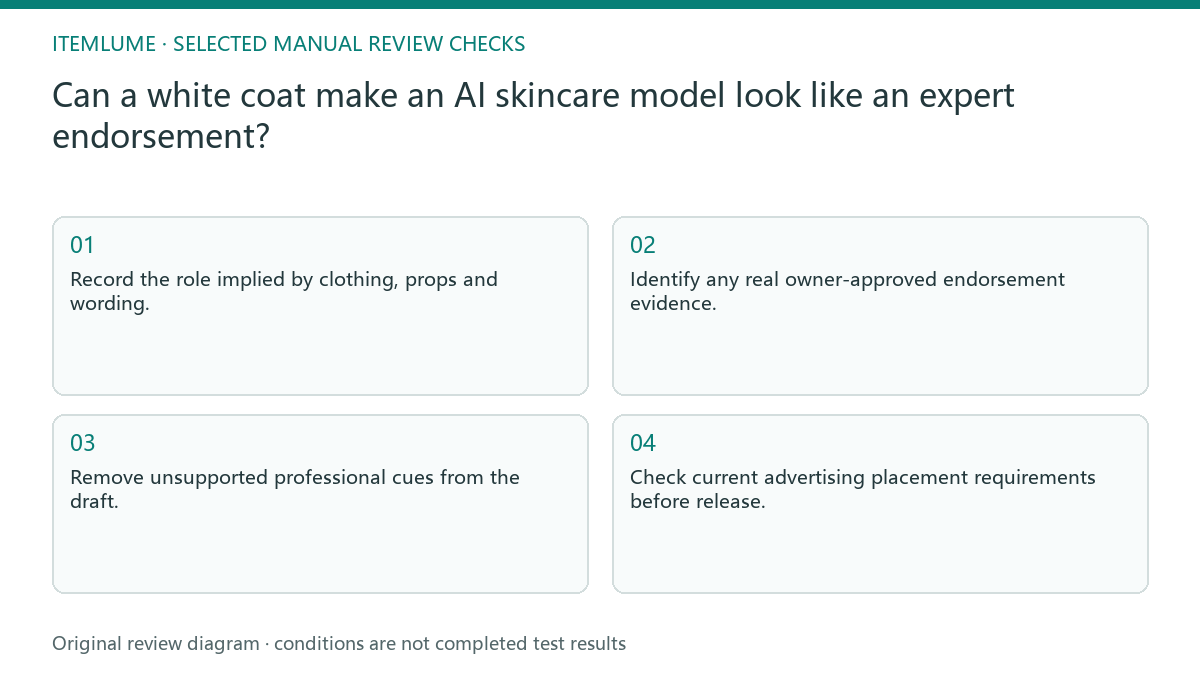
Inventory cues before reviewing claims
List clothing, setting, instruments, captions, gestures and spoken or written claims. An expert-looking role can be created by several modest cues acting together. Ask what a viewer might believe about who is recommending the product and what supports that belief.
Do not interpret a generated face as evidence of employment, qualifications or personal use. A saved model reference establishes a visual identity for creative work, not a medical role. Keep any genuine professional permission or evidence in an owner-controlled record rather than inventing it in the prompt.
Remove unsupported role implications
Choose whether the creative needs an ordinary fictional presenter or an actual documented endorsement. If no expert evidence exists, remove the cues and wording that create that impression. Replacing a white coat with neutral styling can be a draft direction, but the complete result still needs review.
The Xiaohongshu advertising-help page was available only through indexed material in this research. Use it as a current-rule verification lead, not a universal claim about every post or category. The merchant must check the actual advertising placement and approved product claims before publishing.
- Record the role implied by clothing, props and wording.
- Identify any real owner-approved endorsement evidence.
- Remove unsupported professional cues from the draft.
- Ask an unbriefed reviewer to describe the perceived presenter.
- Check current advertising placement requirements before release.
Fictional exercise: an ordinary demonstration looks clinical
This fictional exercise uses a generated skincare presenter wearing a white coat beside a clinical-looking bench. No professional evidence exists. The team intended a texture demonstration, but the draft suggests an expert recommendation. The example is invented, not a real advertising rejection.
They change the role to an ordinary fictional presenter, remove the clinical props and inspect the revised wording together. If the revised image still implies an unsupported expert, it remains on hold. The stopping rule is a supported presentation role, not merely adding “AI-generated” to the image.
Approve role and claims as separate facts
Save the chosen role, supporting record and reviewer interpretation with the creative file. Review product claims independently: an ordinary presenter can still say something unsupported. A professional’s existence, even when genuine, does not establish every efficacy statement in the advertisement.
Model selection, image generation and external advertising review are separate stages. Stop when the presenter’s implied identity and the product wording are supported, and the owner has completed the destination check. Do not call a generated model a verified professional or treat this editorial checklist as platform preapproval.
Presenter-impression audit
| Observation | Manual check | Stop or approve |
|---|---|---|
| White coat | Review complete context | Hold unsupported authority |
| Clinical instrument | Ask role purpose | Remove misleading cue |
| Expert wording | Trace real evidence | Do not invent credential |
| Neutral role revised | Unbriefed interpretation check | Separate claim review |
Use this matrix as a manual review record and add your own real evidence. Its conditions are not completed test results.
Sources and further reading
Sources for this page were checked on . Platform rules can change; verify the current source before publishing. Prompt examples and workflow recommendations are Itemlume editorial guidance, not independently measured results.
Frequently asked questions
Is an AI label enough?
No. It identifies synthesis, not the truth of a role or endorsement.
Does removing a coat guarantee approval?
No. Review the combined scene and the actual advertising requirements.
Can a model reference prove expertise?
No. Visual identity is distinct from professional evidence.
BUILD FROM A PRODUCT YOU KNOW
Put this workflow into practice with your own product.
Explore the relevant tool first. AI copy and concept planning are free after sign-in. Image and video generation require available credits and the applicable account access.
Open Virtual try-on Check pricing and credits