 Itemlume
PRACTICAL ANSWER / Logo studio
Can customers read the letters in my monogram in the wrong order?
Yes. A fused monogram can look balanced while viewers assign the letters in reverse or another order. Test the mark without its brand name, ask unbriefed reviewers to read or describe it, and record their first answer before explaining the intended sequence. Treat appearance and interpretation as separate checks.
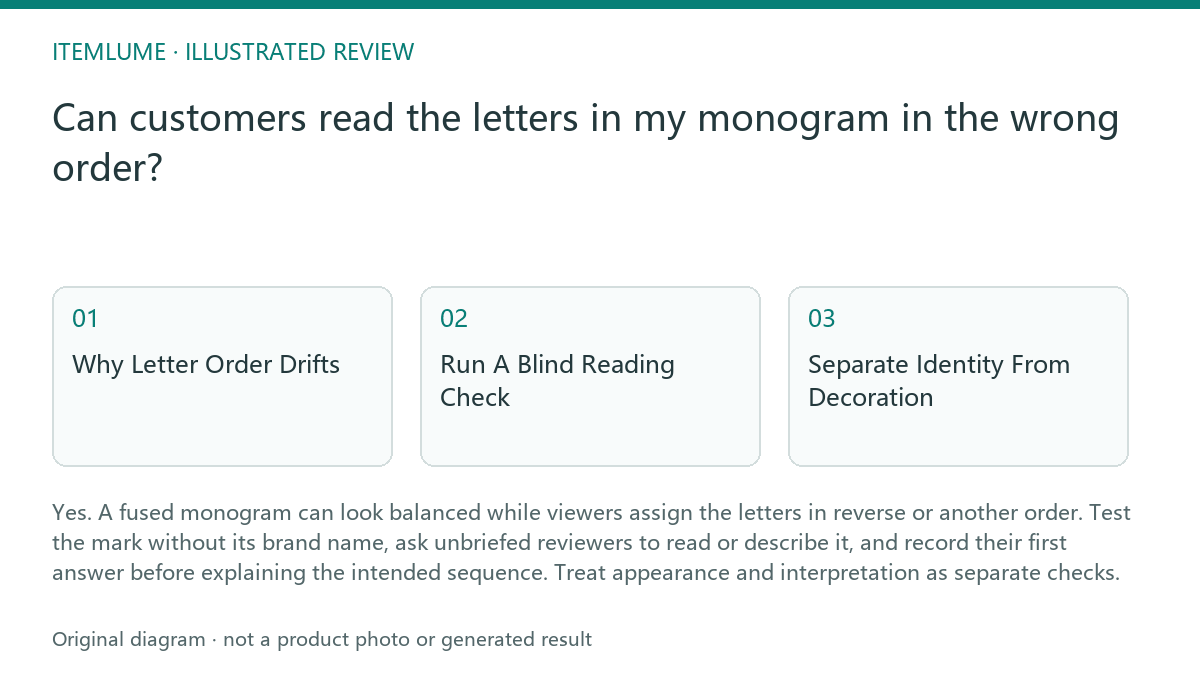
Why Letter Order Drifts
A monogram is often read through entry points: the most prominent vertical stroke, the largest loop, a crossing, or the shape that resembles a familiar letter. When two initials share a stem or enclosure, a viewer may follow the visually dominant form first. That reading can differ from the order specified in the brief even when the construction is deliberate.
Fusion is not automatically a defect. It can make the mark compact and memorable, but it reduces the number of cues available to a new viewer. Do not infer understanding from symmetry, polish, or a designer's explanation. The relevant question is what an unbriefed person says before receiving context.
Run A Blind Reading Check
Use the exact monogram version you are considering, without the wordmark, initials written beside it, or a product mockup that supplies the answer. Show it at a defined size and ask each reviewer one neutral question, such as, "What letters do you see, and in what order?" Record the first response verbatim. This is a user workflow recommendation, not a documented Itemlume testing feature.
Check the sequence below before changing the design:
steps
Separate Identity From Decoration
Compare the intended first letter with the form a reviewer notices first. Look for an oversized counter, a shared stroke that appears to belong to only one letter, or a crossing that hides the start of the second letter. Then inspect the mark in one color and at the smallest planned use size. A detail that explains the order only in a large, colorful presentation is not a dependable reading cue.
Make one controlled change at a time: adjust stroke hierarchy, open a counter, separate a crossing, or alter the overlap. Re-run the same prompt with a fresh unbriefed group or a new review set. Do not report an identification percentage unless you have actually measured it under a defined method. A fictional exercise may use invented observations, but must be labeled fictional.
- Hide the brand name and any written initials.
- Show the monogram briefly at the planned viewing size.
- Ask for the letters and their first-read order without hints.
- Record reversals, omissions, and alternate readings before explaining the intent.
Decide What To Change
If the same reversal appears repeatedly, first test whether the letter order matters operationally. If it does, strengthen the cue for the intended starting letter rather than adding a caption everywhere. If the mark is intentionally ambiguous, document the approved reading and decide where the full wordmark must accompany it. The decision belongs to the brand system, not to visual smoothness alone.
Keep the accepted monogram separate from production claims. Itemlume can support planning after sign-in, while image and video media are quoted separately. It does not publish to stores, produce production vector logos or manufacturing-ready dielines, or prove fit or product performance. A reading test therefore remains a workflow you conduct and document.
Monogram reading review
| Observation | Next check | Pass condition |
|---|---|---|
| Reviewer gives LI when the brief intends IL. | Repeat the blind prompt with the same isolated mark. | The intended order is the first reading, or the reversal is an explicitly accepted choice. |
| One letter is named, while the second is missed. | Inspect shared strokes, counters, and overlap at the smallest planned size. | Both letters have a visible cue in the one-color version. |
| Order is clear only beside the wordmark. | Remove the wordmark and compare the standalone mark. | The standalone version has a documented use rule or communicates the intended order. |
| Reviewers give several unrelated readings. | Test a simpler construction before polishing details. | The leading reading is consistent enough for the approved use. |
Sources and further reading
Sources for this page were checked on . Platform rules can change; verify the current source before publishing. Prompt examples and workflow recommendations are Itemlume editorial guidance, not independently measured results.
Frequently asked questions
Should a monogram always reveal its letters immediately?
No. Some marks rely on familiarity or supporting branding. Decide whether standalone letter order is required for the actual use, then test that requirement directly.
Is reversing the initials always a design failure?
No. It is a problem when the approved identity depends on a specific order and viewers consistently choose another one. Otherwise, document the intended interpretation and usage context.
Can a mockup prove that customers will read the monogram correctly?
No. A mockup adds context and may supply the answer. Use an isolated, unbriefed reading check for interpretation, then review the mark in its planned sizes and colors.
BUILD FROM A PRODUCT YOU KNOW
Put this workflow into practice with your own product.
Explore the relevant tool first. AI copy and concept planning are free after sign-in. Image and video generation require available credits and the applicable account access.
Open Logo studio Check pricing and credits