 Itemlume
PRACTICAL ANSWER / Assets & tasks
Should a third-party tutorial copy my entire guide or publish a shorter original version?
Usually, a third-party tutorial should answer its own readers’ task with original, shorter guidance and link to your full worksheet for detailed checks. Agree on what may be reused, identify the source and publication dates, and describe the relationship accurately. A copy or link can show distribution, but it does not establish independent editorial endorsement.
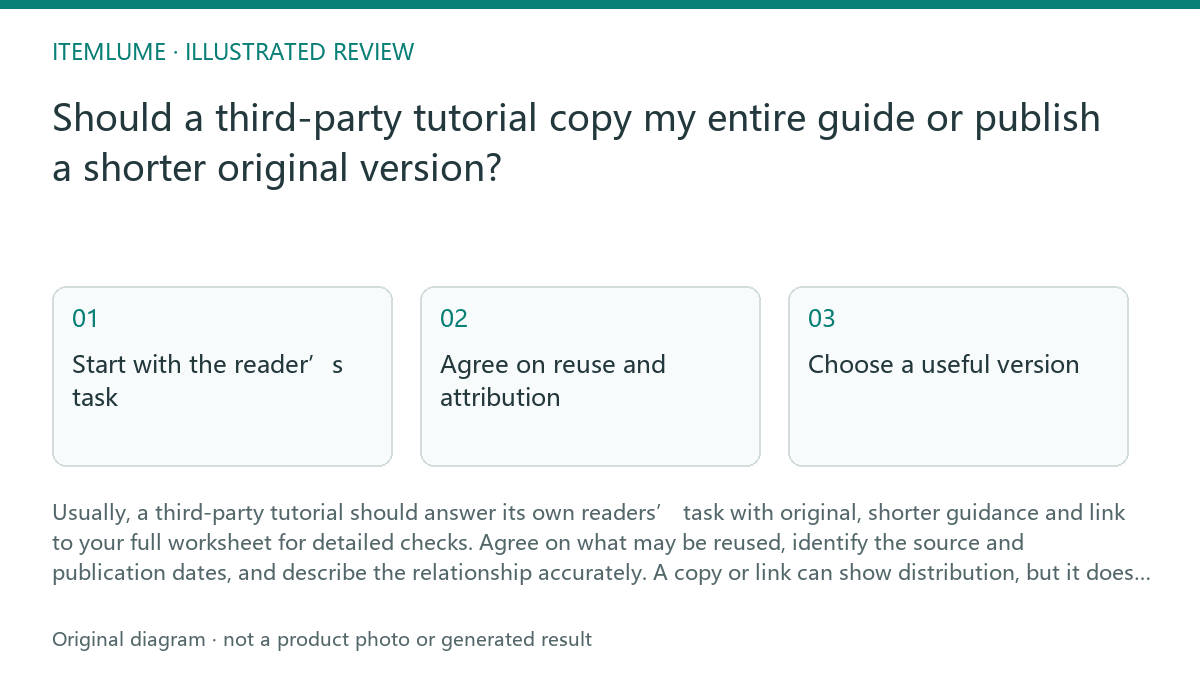
Start with the reader’s task
Ask what the third-party audience needs to do on that page. A LinkedIn article may need a concise approval checklist; your site may hold the full worksheet, examples and detailed review criteria. If both pages reproduce the same complete guide, readers gain little from the second version, and later edits can leave the two copies inconsistent.
Give the external article a distinct job: summarize a decision, explain a narrow step, or present a short checklist in the publisher’s own editorial voice. Link readers to the full worksheet when they need the detailed process. This is a publishing workflow, not a promise that a platform will distribute, rank or endorse either page.
Agree on reuse and attribution
Before publication, specify whether the publisher may quote, adapt, summarize or reproduce the guide. Set a practical excerpt boundary and ask for a link to the source. Attribute the guide and its original publication date; label the third-party page’s own publication or update date separately. Do not imply that a publisher independently tested or approved the material unless that is true.
A linked, shorter article is still third-party self-publication if the author or brand controls its publication. Editorial coverage requires a separate, accurate basis. Report the relationship plainly: for example, “The author published a checklist on LinkedIn that links to the full worksheet.” Do not count copies or links as endorsements.
- Identify the external page’s distinct reader task.
- Agree in writing on the allowed excerpt, adaptation and source link.
- Check attribution, relationship wording and both dates before publishing.
- Compare the live article with the source after either page changes.
Choose a useful version
Keep the detailed worksheet on the page designed for the complete process. The external version can preserve the essential decision points while using its own examples and wording. Link to a relevant section or worksheet, not merely a generic homepage, and make clear what readers will find after clicking.
A short version is not automatically better: it must still let readers complete its stated task without hiding a critical qualification. If a checklist depends on a detailed template, name that dependency and link to it. If the external page needs the full text for a legitimate reader purpose, agree on the scope and maintenance plan before duplicating it.
Review the relationship over time
Treat publication as a maintainable handoff. Record the source URL, external URL, permission or reuse terms, attribution, and dates. When the source changes, check whether the external summary remains accurate; when the external page changes, verify that the link and relationship description still match.
Stop the review when the external article has a distinct reader task, permitted reuse is clear, attribution and dates are accurate, the link works, and no wording suggests independent endorsement without evidence. If any of these checks fails, pause publication or correct the page before describing it as a completed placement.
Third-party publication review
| Observation | Next check | Pass condition |
|---|---|---|
| The LinkedIn article repeats the full worksheet | Compare its reader task and content with the source | Publish a distinct checklist, or document why full reproduction is needed |
| The article links to the guide but names no source date | Check the source attribution and both page dates | Source and external publication or update dates are clearly distinguished |
| A report calls the article an independent recommendation | Check who controlled publication and whether independent review occurred | Describe self-publication accurately, or substantiate a separate editorial review |
| The source worksheet has changed since publication | Recheck the external checklist, link and qualifications | Summary remains accurate and the destination is current |
Sources and further reading
Sources for this page were checked on . Platform rules can change; verify the current source before publishing. Prompt examples and workflow recommendations are Itemlume editorial guidance, not independently measured results.
Frequently asked questions
Does a link from a third-party tutorial prove endorsement?
No. A link shows a relationship between pages, not independent editorial review.
Should the external version use the same publication date?
No. Attribute the source date separately from the external page’s own publication or update date.
When is reproducing the full guide reasonable?
When readers need the complete text and the reuse scope, attribution and maintenance plan are agreed.
BUILD FROM A PRODUCT YOU KNOW
Put this workflow into practice with your own product.
Explore the relevant tool first. AI copy and concept planning are free after sign-in. Image and video generation require available credits and the applicable account access.
Open Assets & tasks Check pricing and credits