 Itemlume
DIAGNOSTIC GUIDE / A+ product pages
How do I explain flat-pack delivery when the hero image shows assembled furniture?
Show the assembled result and describe the actual delivery state separately. A room scene can explain the furniture’s intended use, but it should not leave buyers to assume the item arrives assembled or includes installation service. Confirm those responsibilities from the seller’s real fulfillment information. The shopper must understand what arrives, not merely what the finished room can look like.
The assembled scene does not show delivery state
Finished appearance, packed components and assembly responsibility answer different questions. A scene does not prove which tools are included, how long installation takes or whether a service is offered. Even when every visible component is accurate, missing delivery context can still create the wrong expectation.
Ask what the buyer physically receives and who completes assembly. A styled room can explain the finished use, while its neat construction may conceal boxed parts. Do not infer included tools, installation service or setup time from that scene.
Build a finished-packed-assembly fact sheet
Make a three-state sheet for the assembled product, the actual package and the supported assembly route. Record included parts and confirmed tool requirements. Place a clear delivery-state explanation near the hero promise, keep instructions accessible, and inspect whether any depicted service is genuinely offered by the seller.
Match included panels and hardware to the approved packing list, then record the supported assembly route. Place the delivery-state explanation close enough to the hero claim for a buyer to encounter it. Linking instructions elsewhere does not excuse a contradictory main promise.
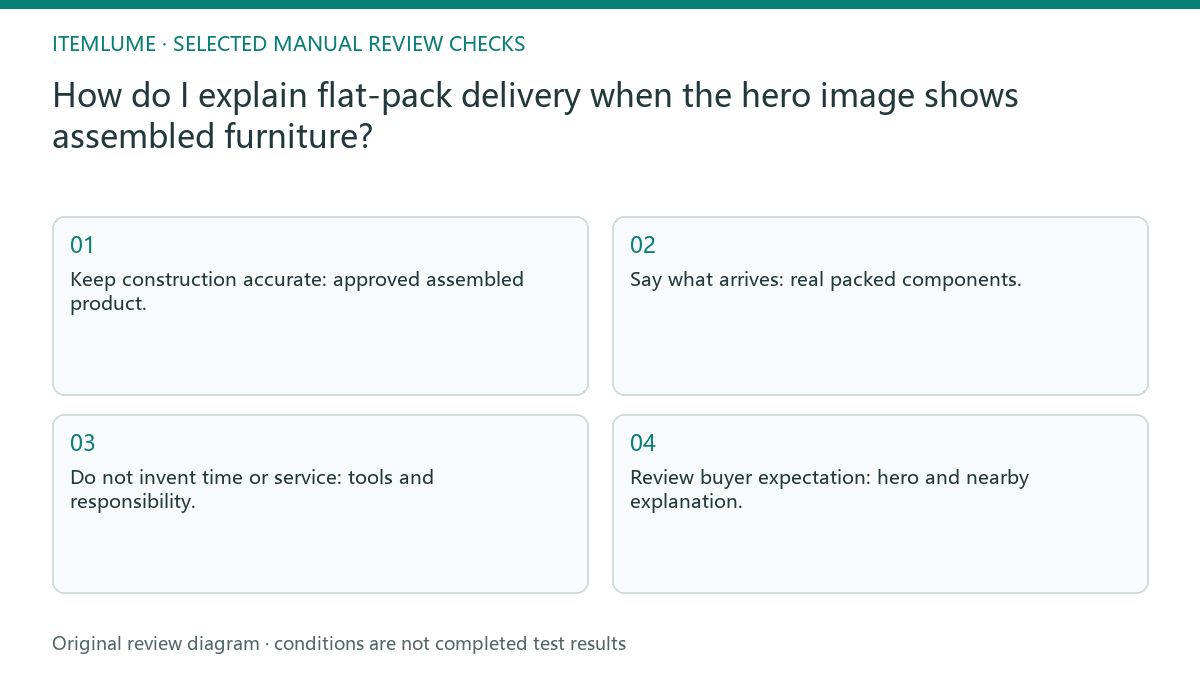
- Keep construction accurate: approved assembled product.
- Say what arrives: real packed components.
- Do not invent time or service: tools and responsibility.
- Review buyer expectation: hero and nearby explanation.
A study desk arrives as separate panels
Fictional exercise: a desk is shown in a styled study but arrives as boxed panels. The seller’s brief explicitly says buyer assembly and lists documented included fasteners. An installation-time estimate is left unknown because no approved record exists. The assembled room image remains a context illustration, not a delivery photograph.
The fictional desk brief identifies buyer assembly and documented fasteners. A reviewer says what they expect to unpack after seeing the hero and adjacent explanation. If they still expect an installer or finished desk, revise the message before changing decorative scenery. If installation is offered only for certain orders or locations, record that scope next to the service promise. Do not use an installer in every hero image by default. A verified assembled state can remain the creative subject while the delivery explanation stays precise.
Make the buyer’s responsibility visible
Stop if the page implies assembled delivery or an installer without a confirmed service route. Correct that promise before polishing the room scene.
Keep uncertain assembly duration and service promises unpublished. The seller must resolve fulfillment facts, and the creative must follow them when delivery arrangements change. The seller owns packing and assembly information. Itemlume can illustrate a verified finished product but does not deliver furniture or validate installation instructions.
Finished state to page promise: decision worksheet
| Check | Evidence to record | Review action |
|---|---|---|
| Finished state | Approved assembled product | Keep construction accurate |
| Delivered state | Real packed components | Say what arrives |
| Assembly route | Tools and responsibility | Do not invent time or service |
| Page promise | Hero and nearby explanation | Review buyer expectation |
Use this matrix as a manual review record and add your own real evidence. Its conditions are not completed test results.
Sources and further reading
Sources for this page were checked on . Platform rules can change; verify the current source before publishing. Prompt examples and workflow recommendations are Itemlume editorial guidance, not independently measured results.
Frequently asked questions
Can the room scene stand in for a delivery photo?
No. State whether the item arrives assembled or as components using actual fulfillment facts.
May I estimate assembly time from the picture?
No. Keep it unknown unless an approved record supports the estimate.
Where should the assembly responsibility appear?
Near the main product promise, with a consistent detailed instruction route.
BUILD FROM A PRODUCT YOU KNOW
Put this workflow into practice with your own product.
Explore the relevant tool first. AI copy and concept planning are free after sign-in. Image and video generation require available credits and the applicable account access.
Open A+ product pages Check pricing and credits