 Itemlume
DIAGNOSTIC GUIDE / Product images
Can packaging alone establish what a product's unseen contents look like?
A packaging image does not establish what unseen contents look like. Do not infer a cream’s shade, texture, or amount, or a food’s granule shape, from a closed container. Obtain a real content reference for the exact SKU or use packaging-only imagery. Label any unrelated illustrative sample clearly and avoid making it look like verified contents.
List what the closed package actually proves
A visible container may support shape, label, color, and closure information. It does not show the material inside. Separate those known observations from unverified internal appearance. Even a product name suggesting a color or flavor does not identify the actual texture, opacity, or particle size.
Ask the merchant which content facts are documented and where the evidence comes from. A supplier catalogue image for another shade is not a matching reference simply because the packaging is identical. Record the SKU, shade or recipe identifier, source date, and whether the interior sample is actually that item.
Request the smallest useful real reference
For a cream, obtain an actual sample photograph showing the visible appearance under identified lighting. For granules, obtain a real close-up with enough scale context to understand shape and quantity. Do not specify laboratory properties or health conclusions from an image; the purpose is a visual representation check.
If a real reference cannot be supplied, keep the package closed in the creative. A decorative smear or ingredient pile can look persuasive but imply unsupported content. The seller should not convert a generic generated texture into a factual product demonstration simply because the scene feels complete.
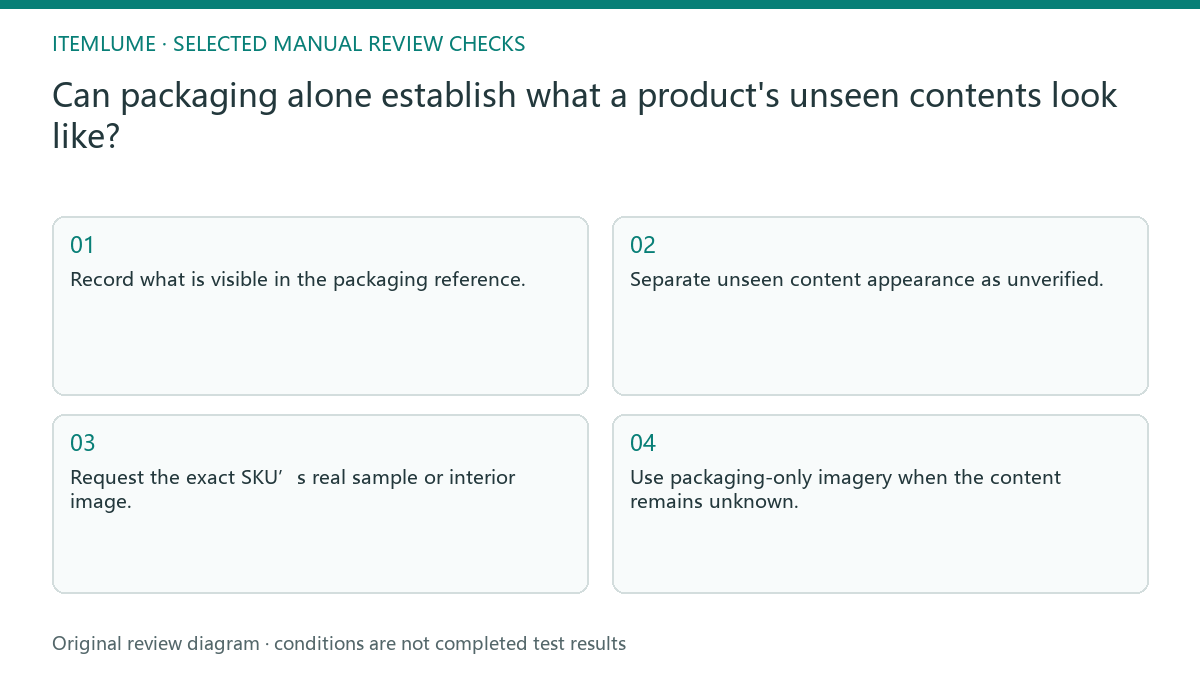
- Record what is visible in the packaging reference.
- Separate unseen content appearance as unverified.
- Request the exact SKU’s real sample or interior image.
- Compare generated content with that source and context.
- Use packaging-only imagery when the content remains unknown.
A fictional tint and granule review
Fictional exercise: two cosmetic shades share an identical jar, but only one has a documented swatch. The review does not apply that swatch to the other shade. A separate fictional pet-food example likewise cannot borrow another recipe’s pellet photograph just because the bags look alike. No contents were tested in either exercise.
The merchant supplies matching reference images or removes the unverified interior demonstration. If the source is too stylized to establish the real appearance, request a plainer photograph. Stop when the pictured material is only a model’s guess; a confident description does not make that texture a product fact.
Keep buyer-visible facts and creative decoration distinct
Review whether the final scene makes a sample appear to be included or representative of the sold quantity. A large swirl beside a jar can imply a product consistency or amount even when no caption says so. Check the image’s meaning, not just whether text contains a claim.
Itemlume can help organize product facts and create imagery from supplied references. It cannot inspect closed packages or confirm formulation, contents, nutritional properties, or safety. Keep an evidence record for visible content claims and stop factual demonstration until the merchant provides an appropriate source.
Package versus contents evidence
| Proposed visual | Needed reference | Decision |
|---|---|---|
| Closed jar exterior | Actual package photograph | Represent visible package |
| Cream shade or smear | Matching SKU swatch | Hold without real sample |
| Granule close-up | Matching recipe content image | Keep shape and scale supported |
| Large displayed quantity | Confirmed amount and context | Avoid unsupported quantity impression |
Use this matrix as a manual review record and add your own real evidence. Its conditions are not completed test results.
Sources and further reading
Sources for this page were checked on . Platform rules can change; verify the current source before publishing. Prompt examples and workflow recommendations are Itemlume editorial guidance, not independently measured results.
Frequently asked questions
Can a product name establish texture?
No. A name is not a visual measurement of unseen contents. Ask for a matching real reference.
Can I reuse another shade’s swatch?
Not as evidence for this shade. Match the exact offered variant or omit the content demonstration.
Does an AI sample prove formulation?
No. A generated material image cannot establish ingredients, health properties, or what is inside the package.
BUILD FROM A PRODUCT YOU KNOW
Put this workflow into practice with your own product.
Explore the relevant tool first. AI copy and concept planning are free after sign-in. Image and video generation require available credits and the applicable account access.
Open Product images Check pricing and credits