 Itemlume
DIAGNOSTIC GUIDE / A+ product pages
Does rechargeable mean the product's battery can be replaced?
Keep rechargeable and replaceable as separate facts. Charging describes how energy is restored; replacement describes whether and how the battery can be exchanged. State user replacement, service replacement or an unknown condition from the actual product documentation rather than inferring it from a charging port. Describe the confirmed capability narrowly, rather than combining plausible battery features into one promise.
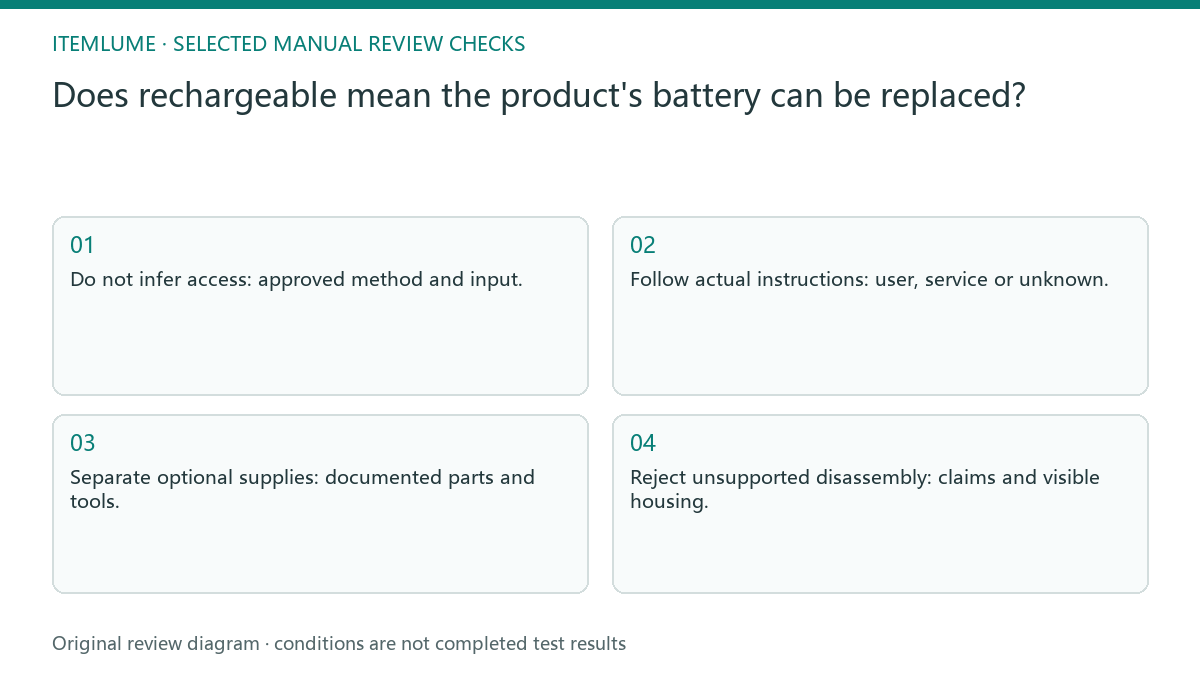
Rechargeable and replaceable are separate capabilities
A rechargeable product may have a sealed battery, a service-accessible battery or a user-accessible compartment. Those states affect the buyer’s maintenance expectations and do not follow automatically from connector shape. A generated exploded diagram or open housing is not evidence that customers are permitted to dismantle the item.
A charging port can suggest an external power route but does not by itself prove user-replaceable batteries. “Wireless” does not define the energy source either. Record the actual model’s approved documentation instead of copying battery features from a visually similar item.
Verify the actual power route and included parts
Read the manufacturer’s instructions for charging, battery access and service. Record who can replace the battery, what parts or tools are actually supplied, and which conditions remain unknown. Align the product copy and images with that record, excluding a user-replacement illustration unless the documentation genuinely supports it.
Make a short capability matrix: charging support, replacement support, included power parts and documented operating conditions. Keep every unknown explicit. Compare the image’s port and accessory depiction with the real item, and remove claims that have no supported row.
- Do not infer access: approved method and input.
- Follow actual instructions: user, service or unknown.
- Separate optional supplies: documented parts and tools.
- Reject unsupported disassembly: claims and visible housing.
A wireless light with an unknown battery arrangement
Fictional exercise: a portable lamp has a charging connector but no confirmed user-replacement procedure. The draft says rechargeable using the approved input description and leaves replaceability unconfirmed. It does not show a customer opening the housing or promise a replaceable battery because the product looks simple.
The fictional light brief initially says “rechargeable and replaceable” because the body looks familiar. The seller confirms only the documented charging route, leaving replacement unapproved. The corrected copy narrows the feature instead of asking the image model to add a battery door. If a supplier confirms replacement, ask who may perform it and what documented scope applies before saying “user replaceable.” Do not describe disassembly from a generated back view. Keep unrelated endurance or safety claims out unless independently supported. Match the power-accessory picture to the sold bundle; staging does not prove included batteries.
Reject inferred battery features from the body image
Stop when access or service responsibility is unresolved. Do not offer disassembly instructions or choose a replacement battery from a photograph.
Stop when the power arrangement is unresolved. The supplier or appropriate product documentation must answer it; creative generation cannot inspect the hidden battery. The seller supplies verified maintenance information. Itemlume copy assistance can explain approved facts but cannot assess battery safety, certify a repair or identify a compatible part from appearance alone.
Charging to creative: decision worksheet
| Check | Evidence to record | Review action |
|---|---|---|
| Charging | Approved method and input | Do not infer access |
| Replacement | User, service or unknown | Follow actual instructions |
| Supplied items | Documented parts and tools | Separate optional supplies |
| Creative | Claims and visible housing | Reject unsupported disassembly |
Use this matrix as a manual review record and add your own real evidence. Its conditions are not completed test results.
Sources and further reading
Sources for this page were checked on . Platform rules can change; verify the current source before publishing. Prompt examples and workflow recommendations are Itemlume editorial guidance, not independently measured results.
Frequently asked questions
Does a charging port prove replaceable batteries?
No. Charging and user replacement need separate documentary support.
Can “wireless” identify the battery type?
No. Verify the actual power arrangement for the model.
May AI add a battery door to support the claim?
No. Correct unsupported copy instead of inventing physical features.
BUILD FROM A PRODUCT YOU KNOW
Put this workflow into practice with your own product.
Explore the relevant tool first. AI copy and concept planning are free after sign-in. Image and video generation require available credits and the applicable account access.
Open A+ product pages Check pricing and credits