 Itemlume
DIAGNOSTIC GUIDE / Assets & tasks
Do Content Credentials prove my AI product photo is accurate or independently approved?
Content Credentials can describe how a file was created or edited; they do not by themselves certify the photographed product’s accuracy or independent approval. Inspect the credential’s actual issuer and recorded actions, then review product identity against real references. A provenance label and a factual product check answer different questions and should remain separate in campaign copy.
Read what the credential actually records
Adobe’s overview describes tamper-evident metadata that can provide context about creation and editing. Its Firefly examples include issuer, date, tools, and actions. Read those fields rather than treating the badge as a general quality mark. A record saying generated describes a creative action, not an inspection of a physical product.
Also note what is absent. The credential may not identify a product SKU, confirm a label, measure dimensions, or establish a rights review. Avoid filling those gaps with assumptions. Record the visible fields and the inspecting tool so another reviewer can understand the scope of the statement.
Run an independent product-fidelity review
Compare the image with real product references for shape, packaging text, color, included components, and anything the scene implies about use. A correctly documented generated image can still contain an extra switch or a wrong cap. Conversely, a real photograph without this credential can still show an accurate product.
Separate the provenance record from the acceptance checklist. One states what is known about the creative chain; the other states what the merchant verified about the depicted offer. Do not use phrases such as independently certified or authentic product proof unless an actual relevant authority and scope support them.
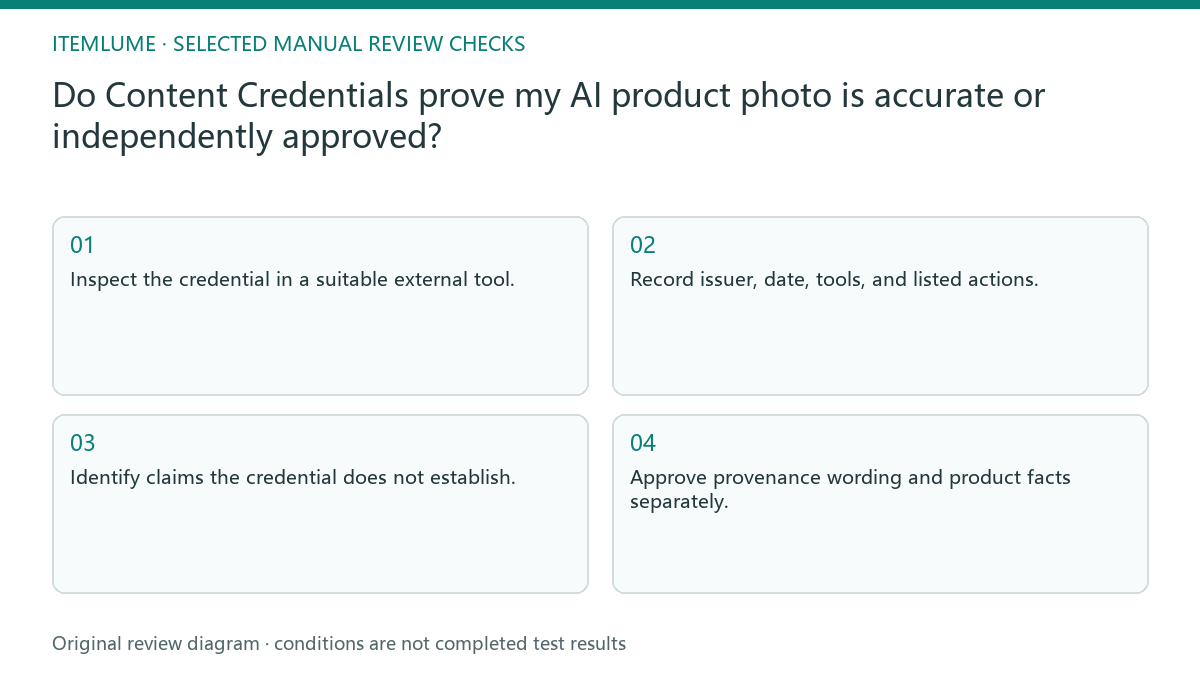
- Inspect the credential in a suitable external tool.
- Record issuer, date, tools, and listed actions.
- Identify claims the credential does not establish.
- Compare the product with real SKU references.
- Approve provenance wording and product facts separately.
A fictional serum-image review
Fictional exercise: a serum campaign image has a credential recording an AI creation action. The picture also contains a silver cap while the real SKU uses a white cap. The creative history can be correctly recorded even though the product representation fails. This is an illustrative example, not a tested file.
The reviewer rejects the product image and keeps the provenance observation separate. If a corrected candidate is later supplied, it needs another comparison against the real reference. The credential alone cannot close the cap mismatch, and the exercise does not claim that a particular tool supplies independent approval.
Describe the asset without borrowing authority
If discussing provenance publicly, state exactly what the inspected credential records and link to the relevant explanation. Do not attach an authority’s name to a product-accuracy claim it did not make. An inspection page is a review interface, not proof that the image was indexed or recommended by an AI assistant.
This guide does not establish that every Itemlume export includes Content Credentials or survives all downstream transformations. Verify the actual file and delivery route. Stop certification-style marketing when the issuer, scope, or evidence is unknown; use a plain description of the documented creation history instead.
Provenance versus product evidence
| Question | Relevant evidence | What it does not prove |
|---|---|---|
| Which tool created the file? | Recorded tool and issuer | SKU accuracy |
| What editing is recorded? | Credential action history | Independent endorsement |
| Does the cap match? | Real product reference comparison | Answered by provenance alone |
| Was this file indexed? | Actual search/index evidence | Proved by credential inspection |
Use this matrix as a manual review record and add your own real evidence. Its conditions are not completed test results.
Sources and further reading
Sources for this page were checked on . Platform rules can change; verify the current source before publishing. Prompt examples and workflow recommendations are Itemlume editorial guidance, not independently measured results.
Frequently asked questions
Does the badge prove the product is real?
No. It can describe file provenance while the depicted product still contains inaccuracies.
Does it guarantee commercial rights?
This credential alone does not establish every permission or legal review needed for the asset.
Can I say third-party approved?
Only if an actual relevant third-party approval exists and its scope supports that exact claim. A provenance issuer is not automatically such an approver.
BUILD FROM A PRODUCT YOU KNOW
Put this workflow into practice with your own product.
Explore the relevant tool first. AI copy and concept planning are free after sign-in. Image and video generation require available credits and the applicable account access.
Open Assets & tasks Check pricing and credits