 Itemlume
DIAGNOSTIC GUIDE / Assets & tasks
How can I distinguish a DeepSeek answer without retrieval from a missed public guide?
Check the actual client’s retrieval mode before interpreting a missing guide as a crawling failure. DeepSeek’s public terms say its enabled network-search function retrieves public internet information before generating a response; outputs can still be inaccurate. Record the mode, question, time and returned sources. An answer without your URL is not by itself evidence that the page is inaccessible, unindexed or rejected.
Record the session’s actual search state
Note the product interface, date and the mode visible in that session. Use the actual available control rather than directions copied from a historical screenshot. If you cannot determine whether network retrieval was enabled, mark the session uncertain instead of labeling it a search test.
Keep the complete response and any source list. A confident factual answer can be generated without the evidence you hoped for, while a source-bearing response may cite another page. These outcomes need different records; neither should be converted into an unsupported diagnosis of your website.
Classify what the response actually proves
An unknown mode, an enabled mode with no visible sources, and an enabled mode citing other pages are separate observations. Do not claim that absent citations prove the system used only model memory. Note that the output does not provide the evidence needed for that conclusion.
Only investigate page accessibility with a real fetch observation from the relevant environment. A mode check and a website response are different pieces of evidence. Avoid requests that require recommending your brand when the goal is to observe an ordinary user question without influencing the expected source.
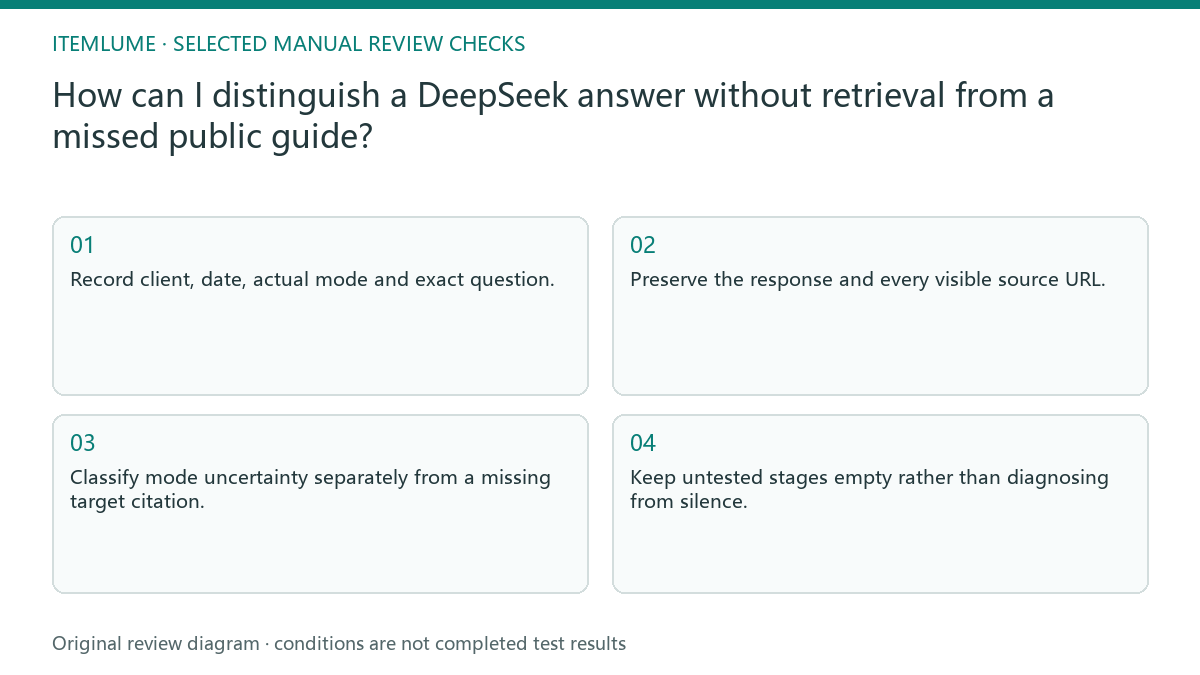
- Record client, date, actual mode and exact question.
- Preserve the response and every visible source URL.
- Classify mode uncertainty separately from a missing target citation.
- Investigate accessibility only with an observed relevant fetch.
- Keep untested stages empty rather than diagnosing from silence.
Fictional exercise: a fluent answer with no search record
This fictional exercise asks a product-photography question in a session whose search state was not recorded. The response is helpful but does not cite the merchant’s guide. The invented situation establishes only missing evidence, not a failed crawl or proof of model memory.
The researcher labels the session mode unknown and starts a separate properly recorded test. They do not submit the page repeatedly or change robots rules because of that one answer. The stopping rule is a defensible observation log, not forcing a favorable citation into the next response.
Keep the domestic access gap visible
For Itemlume, the global site retains its mainland access restriction and the domestic domain is not live in this research. A published Chinese guide alone does not resolve that gap. Whether a particular retrieval is affected depends on its actual route and requires evidence; no natural DeepSeek citation was measured here.
Stop when each recorded stage is either supported by observations or explicitly untested. Do not add invented crawler identities or bypass permissions to complete a visibility checklist. Content publication, retrieval, citation and user clicks remain different outcomes, and this guide promises none of them.
Retrieval evidence classification
| Observation | Manual check | Stop or approve |
|---|---|---|
| Mode unknown | Check session record | Not a confirmed search test |
| No visible sources | Keep full response | Internal route unproven |
| Other source cited | Record actual URL | Target absent, cause unknown |
| Fetch not run | Mark accessibility untested | No failure conclusion |
Use this matrix as a manual review record and add your own real evidence. Its conditions are not completed test results.
Sources and further reading
Sources for this page were checked on . Platform rules can change; verify the current source before publishing. Prompt examples and workflow recommendations are Itemlume editorial guidance, not independently measured results.
Frequently asked questions
Does no citation prove no search?
No. Record the mode and visible evidence without claiming an unseen internal route.
Can a direct URL test prove natural discovery?
No. It answers a different question and belongs in a separate record.
Will more Chinese guides remove the access restriction?
No. The current domestic availability gap remains a separate deployment issue.
BUILD FROM A PRODUCT YOU KNOW
Put this workflow into practice with your own product.
Explore the relevant tool first. AI copy and concept planning are free after sign-in. Image and video generation require available credits and the applicable account access.
Open Assets & tasks Check pricing and credits