 Itemlume
DIAGNOSTIC GUIDE / Logo studio
How do I review an attractive Chinese wordmark with a missing stroke?
Choose a Chinese wordmark only after confirming that its intended name can be read correctly. A missing stroke may be a deliberate design treatment or an unintended character change; appearance alone cannot distinguish them. Compare the exact approved characters with the artwork, mark every alteration, and collect real reader responses rather than inventing a recognition score.
Begin with the approved characters
Record the brand name as text and check its actual characters with the owner. Similar-looking characters, alternate forms, and stylized strokes should not be silently substituted. An attractive generated image is a concept, not a reliable transcription of the name. Keep the text record next to the design proof.
Compare each character separately before reviewing the whole logo. Identify the missing or merged stroke and note whether it changes the structure. A design rationale such as minimalism does not establish that readers will still see the intended character. Ask the owner which changes are deliberate and which were never requested.
Make recognition review observable
Prepare the actual intended display sizes, such as a storefront preview and phone avatar. Ask appropriate readers to write the name they see before revealing the answer. Record their literal responses and the asset version. Do not lead them with the correct name or count a prompted answer as independent recognition.
This is a practical design review, not a universal test threshold. A small convenience sample cannot establish all consumers’ understanding. When responses reveal a different character or hesitation at the missing stroke, revise that point or consider an externally typeset alternative with verified characters.
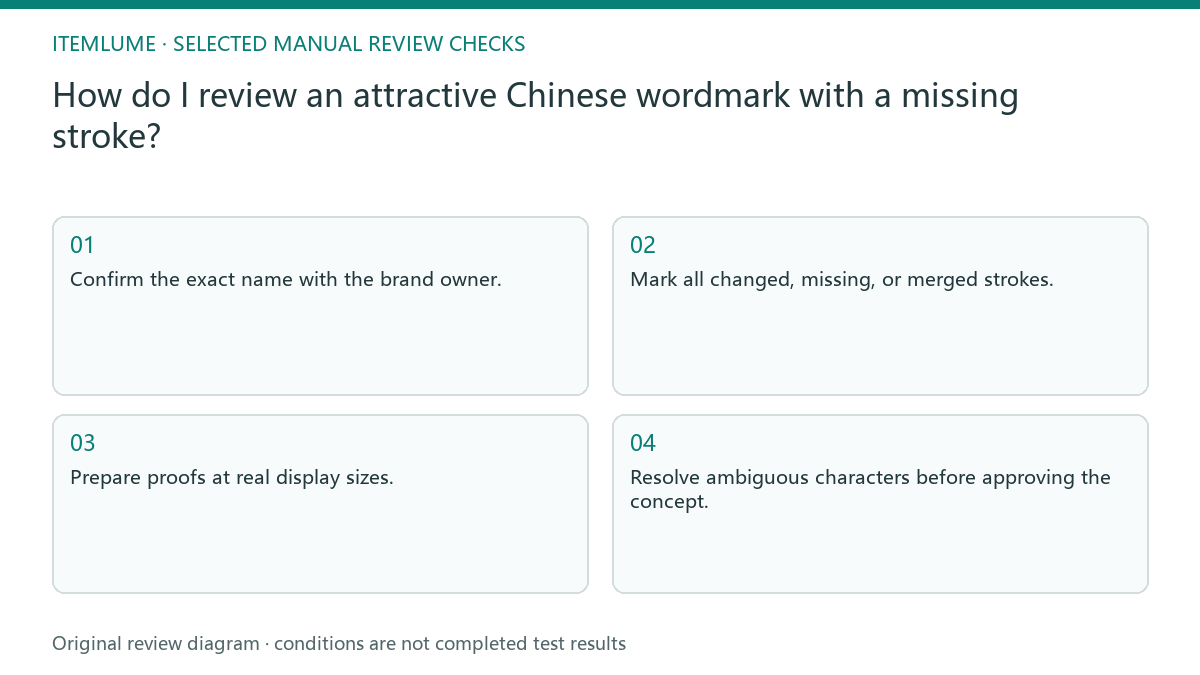
- Confirm the exact name with the brand owner.
- Mark all changed, missing, or merged strokes.
- Prepare proofs at real display sizes.
- Ask readers to transcribe without being told the name.
- Resolve ambiguous characters before approving the concept.
A fictional two-character tea brand
Fictional exercise: a two-character tea brand prefers an elegant AI logo, but one character lacks a distinguishing stroke. The review marks that location and prepares a corrected comparison. This example contains no actual reader study and no measured success rate. Both the brand and the exercise are hypothetical.
If real readers later identify the wrong character, that is evidence to revise the design, not an invitation to explain the correct answer more forcefully. Compare the corrected version at the same sizes. Stop when the owner cannot confirm the exact spelling or the design only works after a verbal explanation.
Separate visual selection from production lettering
An approved concept can still require external lettering work for accurate contours and production use. Keep the corrected character evidence and intended styling together so a designer does not reintroduce the missing stroke while simplifying the mark. Review the final delivered artwork again, not only the chosen thumbnail.
Itemlume logo output is raster concept imagery, not a production font file, editable vector, or trademark clearance. Reading the name correctly does not establish rights or registration. Stop use of an ambiguous concept until lettering is resolved; a beautiful mistaken character is still the wrong brand representation.
Character and reader proof
| Review point | Evidence | Acceptance |
|---|---|---|
| Exact name | Owner-approved text | Correct characters used |
| Missing stroke | Marked comparison proof | Alteration intentional and readable |
| Small avatar | Actual-size unprompted reading | Name not confused |
| Final artwork | Corrected concept comparison | No reintroduced character error |
Use this matrix as a manual review record and add your own real evidence. Its conditions are not completed test results.
Sources and further reading
Sources for this page were checked on . Platform rules can change; verify the current source before publishing. Prompt examples and workflow recommendations are Itemlume editorial guidance, not independently measured results.
Frequently asked questions
Is every missing stroke unacceptable?
Not automatically, but deliberate stylization needs an explicit owner decision and actual recognition review.
Can I explain the name to readers first?
That biases the recognition check. Ask what they read before revealing the answer.
Does readable mean trademark-ready?
No. This review concerns lettering and does not establish rights, registrability, or production-vector delivery.
BUILD FROM A PRODUCT YOU KNOW
Put this workflow into practice with your own product.
Explore the relevant tool first. AI copy and concept planning are free after sign-in. Image and video generation require available credits and the applicable account access.
Open Logo studio Check pricing and credits